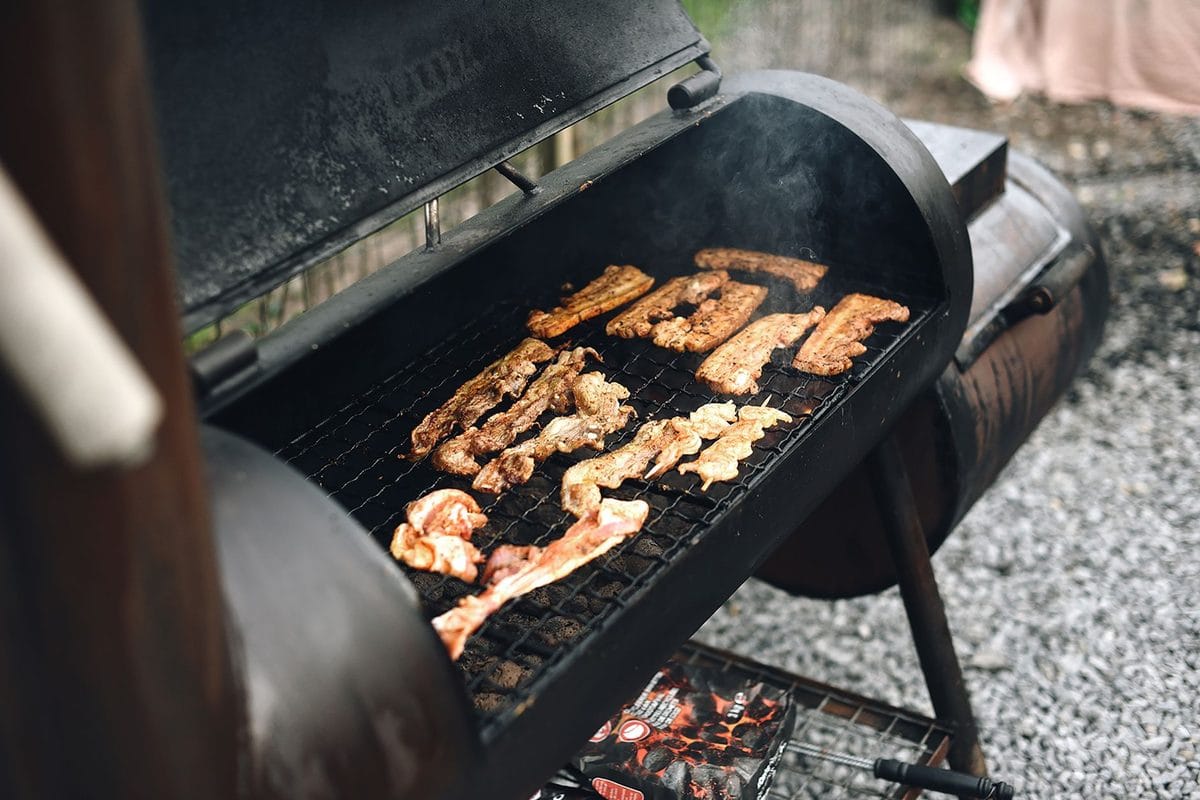
The first cool Saturday of fall is when most backyard cooks find out how much their smoker was coasting on July. Same pork shoulder, same rub, same 225°F setting, and suddenly the thermometer crawls, the fuel vanishes faster than it should, and the meat is still stuck in the 160s when guests start asking about dinner. Nothing is broken. A smoker is a metal box that has to heat its own walls before it can heat the meat, and when the air outside falls from 90°F to 45°F, that box has a lot more work to do. The fixes are small and mostly free, but they need to be in place before you light the fire, not after the first anxious peek under the lid.
Why Cool Air Slows a Smoker Down
AmazingRibs.com's Meathead Goldwyn describes three separate drains on a cold morning. Cold metal pulls heat out of the air inside the chamber, the fire has to suck in cold air to burn, and moisture from the meat and any water pan condenses on the chilly walls like fog on a bathroom mirror, cooling the steel even further. All three get worse as the walls get thinner, which is why a Weber Smokey Mountain or a kettle feels the drop more than a heavy offset does, and why a ceramic kamado takes a long time to reach temperature but holds it comfortably once it gets there. The cold itself rarely damages anything: Traeger says the parts in its pellet grills are rated for temperatures between -30°F and -50°F, so a chilly October morning is no threat to the electronics. What you pay in cool weather is fuel and time. Traeger's support page, written for near-freezing conditions, warns that a pellet grill may run a bit cooler than its set temperature and burn more pellets to hold it, and the USDA lists the weather right alongside meat type, size, and distance from the heat as something that decides how long a smoke takes.
Wind Costs You More Than Temperature Does
A windbreak does more for a smoker than a bigger bag of fuel.
Wind strips heat off the walls and pushes air through the vents, and Traeger lists a slight increase in temperature swings as the usual result on its pellet grills. The USDA's own instructions for smoking a turkey tell you to place the smoker in an area shielded from winds so it can hold a safe cooking temperature. On pellet grills with a downdraft exhaust instead of a chimney, Traeger adds a sharper warning: a wind stronger than 30 mph blowing straight into the exhaust for more than 10 minutes can put the fire out, so point the exhaust at a wall rather than into the breeze.
The obvious shelter is the corner of the patio, and that is exactly where the safety rules push back. The Consumer Product Safety Commission says to keep a grill at least 10 feet from your house or any building and never to use one in a garage, breezeway, carport, or porch, and its winter-weather guidance adds that you should not cook on a charcoal grill in a garage even with the door open. AmazingRibs makes the same point more bluntly, noting that in an attached garage the home's heating system can pull carbon monoxide into the house. The USDA also wants a charcoal smoker in a well-lit, well-ventilated spot away from trees, shrubbery, and buildings. Fall adds a hazard that July never had, which is a yard full of dry leaves, so rake a clear circle around the cooker before you light it and keep spent coals in a metal container until they are completely cold, as the National Fire Protection Association advises. A freestanding windbreak handles the rest: a masonry wall, cinder blocks stacked two high, or a sheet of metal on stakes, set several feet upwind and well clear of the firebox and exhaust.
Preheat Longer and Light More Fuel
Preheating is the step cooks cut short when the weather turns, and it is the one that matters most. AmazingRibs says to bring the cooker up until the metal is too hot to touch and to light more fuel than you normally would. If you usually run a Minion or snake setup for a slow charcoal burn, AmazingRibs suggests skipping it and lighting the whole firebox instead. The catch is that a fully lit firebox burns through its charcoal faster, so check your fuel earlier than your summer routine tells you to.
A heavy, insulated cooker is the exception. According to AmazingRibs, ceramic kamados and similar insulated pits use a lot of fuel and time getting up to temperature, but once they arrive, holding it is much less of a problem, which is a point in their favor if you are still deciding between a pellet, offset, or kamado for your first real smoker. Offset owners can put bricks in the chamber to soak up heat and radiate it back, a trick AmazingRibs recommends year-round.
Keep the lid closed. AmazingRibs tested the old "if you're lookin', you ain't cookin'" rule and found that opening the lid costs little in warm weather, but in the cold it has a more profound impact, even though the temperature recovers fairly quickly once the lid goes back down. Pellet grill owners get a slightly different checklist. Traeger says pellets should be fresh and dry, with a shine, and that they snap easily, that the grill should be kept clean so they burn efficiently, and that ignition may run slower near freezing, so give it time before you assume something is wrong. Keep the bag sealed and the hopper lid closed between cooks, because moisture is what ruins pellets.
Before the first real cook of the season, spend an hour with the smoker empty:
- Time how long it takes to reach 250°F with the lid closed on a morning that feels like your cook day, and write the number on a sticky note you leave by the cooker.
- Clip a second thermometer to the grate next to the one in the lid. The two often disagree, and the grate reading is the one your meat actually experiences.
- Stand where the wind hits. A spot that felt sheltered in August may not be once the trees thin out.
- Empty last season's ash and check the small stuff, such as a sticky damper or a worn door gasket, among others, since leaks waste the extra fuel you are about to burn.
Cook to Temperature and Build in a Cushion
The USDA says smoking can take anywhere from 4 to 8 hours and calls thermometers imperative: one for the air in the cooker, which it wants kept between 225°F and 300°F the whole time, and one for the meat. Traeger's cold-weather advice comes down to the same instruction, to cook to temperature rather than by time. Pull the meat by internal temperature, not the clock, and remember that the USDA's safe minimums are 145°F for whole cuts of beef, pork, and lamb, 160°F for ground meat, and 165°F for poultry. Cuts like pork shoulder and brisket run well past those numbers, because they only turn tender once the collagen has broken down.
Start earlier than the recipe says. If you think a shoulder needs to be on at 6 a.m. for a 6 p.m. dinner, put it on at 4 and plan to hold it. Wrap the finished meat in foil and towels, tuck it into an empty cooler, and check with a probe that it stays at or above 140°F, the line the USDA draws for keeping hot food hot. A cook that finishes early and waits in a cooler is a relaxed dinner; a cook that finishes late is a hungry crowd staring at the lid.
There is one more thing the calendar changes. Daylight saving time ends on Sunday, November 1, 2026, so sunset arrives an hour earlier by the clock and the last stretch of a long cook increasingly happens in the dark. A clip-on light or a headlamp costs less than guessing at a firebox by feel.
Do You Need an Insulation Blanket?
Not in early October. Traeger treats its insulation blanket as optional, and its support page for the Pro 575 and 780 recommends it only when outdoor temperatures are below freezing and the grill is running at 350°F or lower (a Traeger guide on its site puts the line at 35°F). Until you are near those numbers, placement and preheating do most of the work, so buy the windbreak before you buy the blanket.
When real cold arrives, AmazingRibs lists welding blankets, Reflectix foil insulation, and wraps around the cooking chamber as workable options, with two conditions. Leave the airflow alone, because blocking oxygen in and smoke out can starve the fire or leave gray, sooty smoke on the food. And keep insulation off the firebox, since materials like Reflectix can melt if things get too hot.
John Dawson of PatioDaddioBBQ.com, quoted by AmazingRibs, has the whole plan in three sentences: "Treat your cooker like you treat yourself when it's cold. Keep it dry, keep it out of the wind, insulate, and take in more calories (fuel and oxygen)." Notice where insulation sits in that list.
What to Put on While the Weather Is This Good
Cool weather is not the enemy of low-and-slow cooking; it is the other half of the calendar from the problem covered in our guide to running a smoker through a heat wave. Traeger notes that above 85°F a grill can struggle to stay below 225°F, which is why Traeger suggests starting low-and-slow cooks after the sun has set. Between the two extremes sits the most forgiving smoking weather of the year, and the long cuts take the best advantage of it.
Pork shoulder is the safe bet, because its fat covers for a lot of small mistakes, and it still hits the plateau explained in our piece on the barbecue stall. Chuck roast is the forgiving stand-in when brisket feels like too much commitment, and beef ribs pay off the patience of a long afternoon. Save wings and anything else that needs a hot chamber for a calm day, since a windy fall morning will fight you on every degree.
Thanksgiving falls on Thursday, November 26 this year, which makes the next few weekends your rehearsal. A smoker that holds 250°F on a windy 45°F morning in October will hold it on the day that matters, and a smoker that does not is far cheaper to discover now, with a pork shoulder on the grate instead of a twenty-pound turkey.