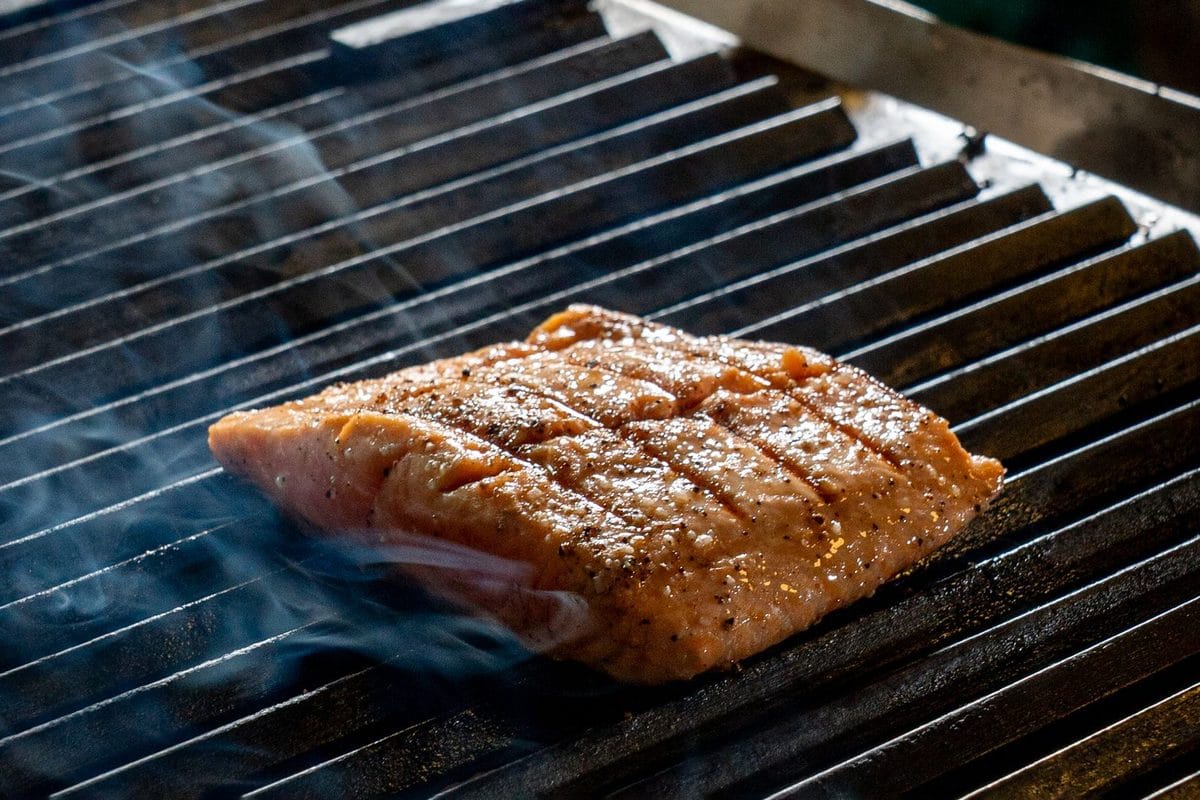
A side of salmon in the fridge and a smoker you have already fired up is a good reason to start early. Hot-smoked salmon takes most of a day, but almost none of that time needs your hands, and the result is flaky, smoky salmon you can portion however you like. The part that matters most is not the wood. It is the food-safety step, and that step comes down to numbers you can check. The figures below come from a university extension guide, the USDA and a thermometer maker's guide, so you can verify each one against its source before you light the fire.
Hot smoke, not cold, for fish you plan to eat
Cold-smoked salmon, the silky lox on a bagel, is a different product. The University of Alaska Fairbanks Cooperative Extension says cold smoke keeps the internal temperature below 90°F, which places the whole process inside the 40 to 140°F danger zone, and that cold-smoke temperatures are not hot enough to kill bacteria. Why not cold-smoke it for that texture? Because the process leaves the fish in the zone where bacteria grow, and ThermoWorks, a thermometer maker, says cold smoking "may be best left to seafood processing experts" with strict sanitation. Hot smoking holds the chamber well above the danger zone, and the kill step is the internal 160°F hold described below. For a home smoker, the choice is simple: hot-smoke the salmon, and leave the lox to the processors.
Why 160°F, not the 145°F on the chart
The USDA's safe minimum internal temperature for fish and shellfish is 145°F, and that number is the floor, not the home hot-smoking target. For hot smoking at home, the University of Alaska Fairbanks extension guide asks for 160°F internal, held for at least 30 minutes at some point in the cycle and preferably toward the end. Its reason is that 160°F kills most food spoilage bacteria, and that matters because lightly salted smoked fish is not a preserved product. Most food poisoning bacteria can grow under the conditions normally used to prepare and store smoked fish. Put the probe in the thickest part of the fillet, and treat 160°F as the number that counts, not the color of the flesh.
Brine with kosher salt, and chill it first
Fatty fish is the forgiving choice here. The UAF guide notes that salmon and black cod brine and smoke much more easily than lean fish, while low-fat fish such as halibut absorb salt fast and can turn too salty. Use kosher, pickling or canning, or flake salt for the brine. Skip rock salt, sea salt and iodized salt, because the impurities and additives in them can leave bitter or off flavors, and avoid curing salts, which contain nitrites that are hard to spread evenly at home. Cut the fillet into pieces no thicker than an inch, since UAF also warns that pieces thinner than that can spoil during smoking. The guide allows sugar and pickling spices in the brine for extra flavor, so you can sweeten the fillet without changing the safety steps.
- Make a medium brine with 1½ pounds of salt per gallon of water, and chill it to 38°F or lower before the fish goes in.
- Brining runs from 20 minutes to three hours, depending on how salty you want the result.
- Soak the fish in fresh water for 30 to 60 minutes if it spent an hour or more in the brine.
- Use three parts brine to one part fish, mix a fresh batch every time, and so on.
Dry the fish until the surface turns tacky
Drying does two jobs, according to UAF. It lets the salt spread evenly through the flesh, and it forms a pellicle, the tacky, shiny skin that seals in moisture and improves the finished look. Keep the fish refrigerated below 38°F during that equilibration, which can take anywhere from 2 to 24 hours depending on thickness. A one-inch fillet typically needs about 6 to 8 hours. Then move it to a warm smoker, not a hot one, with no wood chips yet, and let the pellicle form for 30 minutes to three hours. The fish is ready for the smoke when the surface feels tacky and slightly shiny and the flesh feels noticeably firmer.
Set up the smoker for a steady chamber
The smoker has two jobs in this recipe, and they need different settings. First it warms the fish gently for the pellicle, with no chips in the box. Then it runs the long smoke that carries the fish toward 160°F, and the chamber has to sit above that number, because a piece of fish cannot heat past the air around it. Low and slow is the right instinct for texture, but a chamber that never gets above 160°F will never bring the fish there. Watch the chamber with an air probe and a low alarm, as ThermoWorks recommends, so a drop shows up before the timeline does. Alder and apple are the mild choices for salmon, and they stay out of the way of the fish. Once the chips go in, close the lid and resist the urge to check every few minutes, because each time the lid opens the chamber loses heat and the clock keeps running.
The timeline for a one-inch fillet
| Step | Target | Time (per UAF) |
|---|---|---|
| Brine | Medium brine, chilled to 38°F or lower | 20 minutes to 3 hours |
| Equilibrate | Refrigerated, below 38°F | 2 to 24 hours; about 6 to 8 for a 1-inch fillet |
| Pellicle | Warm (not hot) smoker, no wood chips | 30 minutes to 3 hours |
| Wait before raising internal temperature | Fish in the smoker with chips going | 3 to 5 hours |
| Reach 160°F | Internal, thickest part | Within 6 to 8 hours of loading |
| Hold | 160°F internal | At least 30 minutes |
| Total smoke | Depends on the finished product | 6 to 15 hours |
UAF says a typical cycle brings the fish to 160°F within six to eight hours of loading, and it advises waiting three to five hours before raising the internal temperature, because raising it too fast causes curd formation and "exploded" pieces. If the smoker cannot get the fish to 160°F, UAF suggests a final bake in a 300°F oven, holding 160°F for at least 30 minutes. ThermoWorks, for its part, recommends an accurate thermometer with an air probe and a low alarm, so you know when the chamber drifts out of range.
There is a trade-off inside the timeline. UAF notes that shorter heating and smoking times leave a moister finished product, which tempts anyone who wants a softer fillet to rush. Treat the 160°F target and the 30-minute hold as fixed, and treat the total smoke time as the part you can trim.
When the fish goes wrong
Most problems trace back to the timeline or the salt, and the UAF guide names both. Check the list before you blame the wood.
- White curd or "exploded" pieces come from raising the internal temperature too quickly, according to UAF, so the three-to-five-hour wait is the fix.
- Flesh that tastes too salty usually means a lean fish sat in a strong brine too long, since low-fat fish absorb salt quickly.
- Dry fish points back to the total smoke time, because UAF says shorter heating and smoking times leave a moister product.
- If the smoker never reaches 160°F, move the fish to a 300°F oven and bake it until the probe holds 160°F for at least 30 minutes, and so on.
Store it cold, eat it soon
UAF calls storage the most important step in producing smoked fish, and the reason is simple: most smoked products have had no preservation step. Refrigerate the fish below 38°F, wrapped tightly, and expect lightly salted smoked products to last about 10 to 14 days. For longer keeping, wrap it for the freezer, where properly protected smoked salmon lasts two to three months. Never leave smoked fish at room temperature, because the extension warns that Clostridium botulinum, the bacteria that can cause botulism, is the most harmful of the bacteria that can grow in it. Plan the batch around the days you will actually eat it, and freeze the rest the day it comes off the smoker.
Trust the probe over your nose, and write down the time you loaded the smoker.