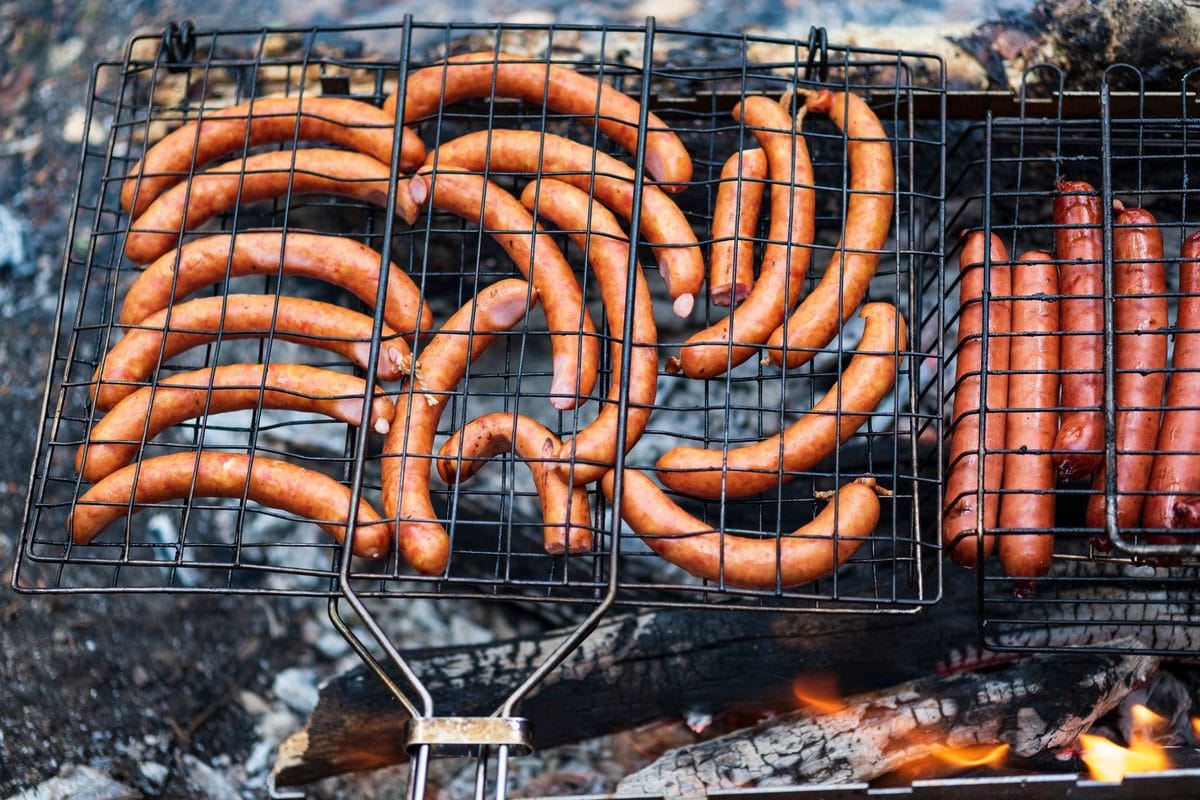
Somewhere in a parking lot this fall, a foil pan is balanced on a camp burner with a dozen raw brats floating in lukewarm beer, going pale and a little gray while the sliced onions underneath turn soft. It looks like tradition, so almost nobody questions it. Munich's Oktoberfest closed on October 4 after running since September 19, the mornings have finally turned cool enough to feel like football season, and a smoker offers a better route than that pan: raw brats on the grate at 225°F, an hour or two of apple smoke, and a casing that browns instead of boils. The beer bath still has a job to do. It just isn't the job most recipes hand it, and it belongs at the end of the cook rather than the start.
Three Camps, One Pot of Beer
Meat Church, the barbecue rub company, simmers raw brats in beer over butter-cooked onions until the sausages hit 165°F, which it puts at about 20 minutes, though it prefers 45, and then finishes them over direct heat for char. Its stated reason is that the simmer tightens the casings and keeps the brats from bursting. Stittsworth Meats, a butcher shop in Bemidji, Minnesota that dates to 1940, argues the opposite: boiling washes the seasoning out of the meat and flattens the texture, so its brats go onto the smoker raw. The third camp is Wisconsin's. A widely used Sheboygan-style recipe on Allrecipes grills the brats first, drops them into a beer-and-onion sauce for 10 to 15 minutes, and serves them on hard rolls, which puts the bath after the heat instead of before it. Each camp has a real argument, so it helps to look at an actual test.
J. Kenji López-Alt ran one for Serious Eats, though with sealed bags in a sous vide bath rather than a pot on a stove. He cooked bratwurst alongside an IPA, a light lager, and a saison, expecting beer-flavored sausage. What he got was the reverse: the sausages lost flavor, because beer is mostly water and draws salt and other flavor compounds out of the meat, so the cook ends up adding sausage flavor to the beer. His fix was to season the beer heavily with salt, which evens out the pressure pulling on the sausage and keeps its own flavor where it belongs. A bag is not an open pot, and a sous vide bath is not a smoker, so take the result as an explanation rather than a final ruling. It lines up with the butcher's complaint, though, and it goes a long way toward explaining why the onions in a beer bath usually taste better than the brats do. The call here is to skip the pre-boil, smoke the brats raw, and give the beer a second job once the smoke is finished.
Buy Raw Brats and Read the Label
Buy raw brats.
Traeger's advice is to choose uncooked bratwurst, because the cooked kind has usually been pre-boiled, which shortens the cook but dilutes the natural flavor before the sausage ever meets smoke. The same guide describes the ideal brat as roughly 70 percent lean and 30 percent fat, which at a butcher counter looks like pink meat flecked with white and in a sealed pack mostly means trusting the brand. Johnsonville, based in Sheboygan Falls, Wisconsin, sells its Original Bratwurst in 5-count packs, and its grilling directions are a good template for what any label should tell you: cook until browned, with an internal temperature of 160°F. The USDA's Food Safety and Inspection Service draws the same line at 160°F for uncooked sausage made with ground beef, pork, lamb, or veal, and at 165°F for sausage made with chicken or turkey, so a cooler holding both needs a thermometer, not a timer. Fresh sausage is also a short-dated product, since the USDA gives it just 1 to 2 days in the refrigerator or 1 to 2 months in the freezer. A pack bought on Thursday for a Sunday cook should go straight into the freezer and come out to thaw in the refrigerator on Saturday night. Stittsworth says fridge-thawed brats smoke more evenly than frozen ones, though frozen brats can still go on the grate if you plan on closer to two hours.
Setting Up the Smoke
Aim for 225°F and treat 250°F as a ceiling. Stittsworth says that above 250°F the fat renders too fast and the casing splits, which turns a juicy brat mealy, and Traeger sets its own cap at 275°F, warning that anything hotter makes brats burst and burn. On a cool October morning the smoker will fight you for every degree, so allow extra preheating time and shelter it from the wind, as covered in our guide to smoking meat in cooler weather. Time depends on the sausage: Stittsworth quotes 60 to 90 minutes at 225°F, Traeger says 1.5 to 2 hours, and the gap comes down to link diameter and how cold the brats were when they went on. Whatever the clock says, the thermometer makes the decision.
Four choices matter more than the rest, with plenty left to personal taste:
- Wood: apple, hickory, or oak. Stittsworth calls apple the safe pick, hickory the right partner for cheese-stuffed brats, and oak the middle ground.
- Mesquite is where the sources split. Traeger lists it among its favorite pellets for brats, while the butcher calls it too aggressive for sausage at these times and temperatures. Skip it.
- Spacing and casings. Leave room around each link so smoke and heat reach every side, and don't poke holes, because each one is a leak for the fat that carries the flavor.
- Probing through the open end of the casing, which is Traeger's way of taking a reading without letting the juices run out the side.
Pull at 160°F, Then Decide About the Sear
Pull the brats at 160°F. Stittsworth warns that past 170°F the casing tightens, the texture dries out, and the first bite squirts onto your shirt, and since 160°F is already the USDA minimum for pork and beef sausage, there is no reason to aim higher. Rest them for about five minutes (Stittsworth's number; Traeger says 5 to 10).
Smoke gives you flavor but not crunch, which is why Traeger suggests finishing over direct heat, either a quick sear or another 5 to 10 minutes with the grill turned up to 400°F. A workable rhythm is to start the sear when the brats read about 150°F, turn them every minute or so over a hot grate or in a cast-iron skillet, and take them off the moment the thermometer says 160°F. That puts the browning inside the cook instead of on top of it, so nothing drifts toward 170°F while you admire the color. Brats that skip the sear are still good, especially the stuffed varieties where the filling is the point, but they won't have the snap that makes a ballpark brat feel like one.
Where the Beer Bath Earns Its Place
After the sear, the bath works as a warming tray with flavor on the side. Put sliced onions, a few tablespoons of butter, and a bottle or two of inexpensive lager (Leinenkugel's, Yuengling, or Miller High Life will all do) in a foil pan, bring it to a simmer on a burner or the hot side of the grill, and salt it more than feels natural, given López-Alt's finding. Meat Church caramelizes three medium sweet onions in 2 tablespoons of butter for about 20 minutes before any beer goes in, and that step is what makes the bath worth the trouble. The finished brats can sit in the liquid and stay juicy while the game goes on, and the onions end up on the bun, which is where the beer flavor was always going to land anyway.
Keep that pan hot. The USDA says bacteria grow rapidly between 40°F and 140°F and that cooked food should be held at 140°F or warmer, which rules out the lukewarm tailgate pot. Check the liquid with the same thermometer you used on the brats, and if it reads under 140°F, bring it back to a simmer before the next round goes in.
There is one situation where the pre-boil is the sensible call. If thirty people are arriving at kickoff and the smoker is already full of a pork butt, Meat Church's method will get raw brats fully cooked in well under an hour on any burner, ready for a hot finish on the grate. That is a scheduling decision, and a perfectly good one, but it isn't a flavor decision, and nobody should tell guests the beer seasoned the sausage.
Working Backward From Serving Time
- The night before, move the brats from the freezer to the refrigerator, and slice the onions if you want a head start.
- Three hours before serving, light the smoker and let it settle at 225°F, with extra time if the morning is cold or windy.
- Two and a half hours out, the brats go on, spaced apart, lid closed, with apple or oak.
- Start probing at the 60-minute mark. Most will need longer, and the ones that run to two hours are not behind schedule.
- At about 150°F, move them to the sear. At 160°F, they come off for a five-minute rest and then into the hot onions.
Buns, Mustard, and Whatever Is Left
The Allrecipes submitter from the Sheboygan area grew up eating brats on old-fashioned hard rolls, and Traeger lists a classic brat bun, a pretzel bun, and brioche as the usual choices. A pretzel bun is the better pick for a smoked brat, because the chew holds up to a pile of onions, and sauerkraut with spicy brown mustard does more for smoke than ketchup ever will. German potato salad, coleslaw, and fries are the sides Traeger recommends, and none of them argue with the sausage.
Leftovers follow the USDA's two-hour rule: cooked brats go into the refrigerator within 2 hours of coming off the heat, or within 1 hour if the afternoon is above 90°F. The agency says sausage you cooked yourself keeps 3 to 4 days in the refrigerator and 2 to 3 months in the freezer, and that anything reheated should reach 165°F. Slice a cold brat into coins, brown them in a skillet with the leftover onions, and Monday's breakfast scramble is mostly built.