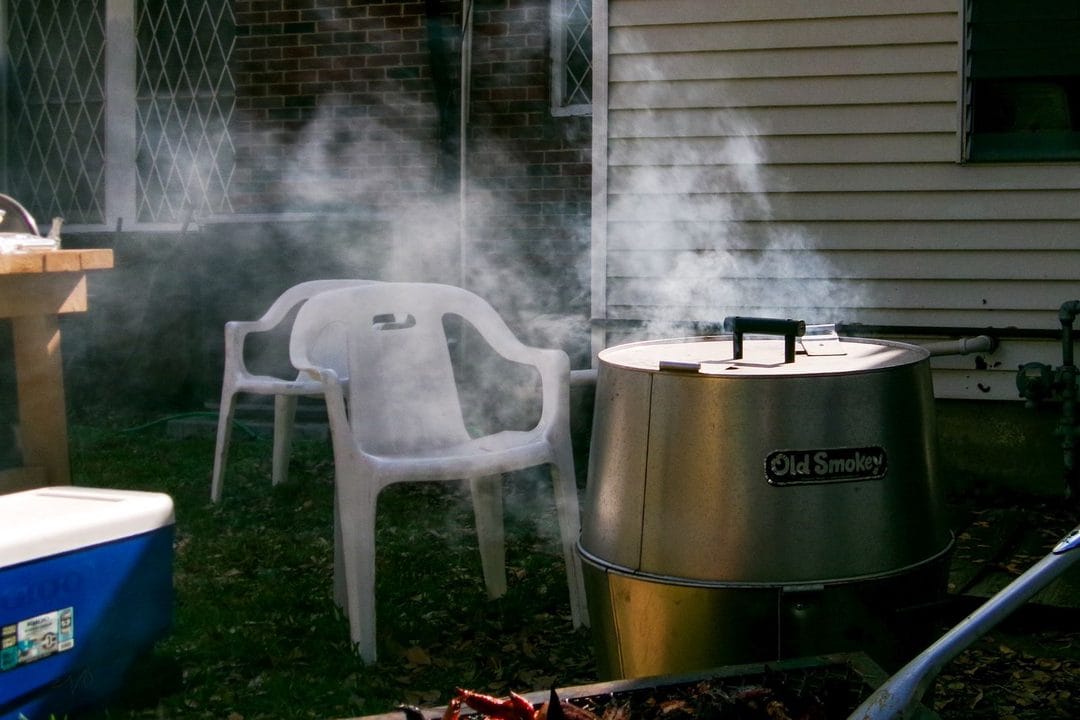
The porch thermometer already reads 84 degrees at six in the morning, and the pork shoulder has another eight hours to go before it hits 203°F internal. By ten it will be past 95. By two it will be sitting somewhere close to 102, the kind of heat that makes the driveway asphalt go soft underfoot and turns a folding chair into a punishment. Running a smoker through that kind of day isn't the same job as running one in April. The fire behaves differently, the meat behaves differently, and so does the person standing next to it with a beer that's gone warm in twenty minutes flat. Early August is exactly when most backyard cooks in the South and the Southwest hit this wall for the first time each year, usually mid-cook, usually with no plan for it beyond gritting their teeth. There's a better way to run the whole day than just toughing it out.
Most advice about barbecue in hot weather stops at "drink water," which is true but useless on its own. A pit that's been dialed in perfectly for months can suddenly run 25 or 30 degrees hotter than usual once August sun is hitting the barrel directly, and that swing is enough to turn a slow-and-steady cook into a scorched exterior with a cold center. The good news: none of this requires new equipment or a different style of cooking. It requires paying attention to a few things that matter more in July and August than they do the rest of the year — airflow, shade, hydration, and a food thermometer you actually trust.
Why Heat Wrecks a "Low and Slow" Cook
A charcoal or wood smoker holds its temperature through a balance of fuel burn rate and airflow through the vents, and that balance assumes a certain amount of heat loss to the surrounding air. On a 55-degree spring morning, a smoker radiates heat fast enough that the fire has to work to maintain 225°F. On a 100-degree afternoon with the barrel sitting in direct sun, that same fire barely has to work at all — heat loss drops, residual sun-warming adds its own few degrees, and suddenly a pit that used to hold rock-steady at 225°F is creeping toward 260°F with the same vent settings you used last month. Pellet smokers fight this a little better because the auger and fan are doing active temperature control, but even a Traeger or a Rec Tec will run hotter and burn through pellets faster on a scorching day, since the controller is fighting harder against ambient heat gain than the marketing copy admits.
Wind makes it worse. A 100-degree day with a 15 mph gust across an open backyard pulls oxygen through the firebox unevenly, spiking temperatures on one side of the grate and starving the other. This is the exact scenario that produces the classic complaint of "half the brisket was perfect, half was dry" — it's rarely a seasoning or timing problem, it's an airflow problem made worse by heat and wind working together.
Protecting the Fire When the Thermometer Outside Reads 100°F
Move the smoker into partial shade if you have any option to do so — even the shadow cast by a fence or a shed for three or four hours in the middle of the day makes a measurable difference to how hard the fire has to work. Close vents slightly earlier in the cook than you would in cooler weather; a vent setting that held 225°F in March might need to come down by 10 to 15 percent to hold the same number in August. And check your fuel more often than usual, because charcoal burns faster in heat-stressed conditions even as the pit temperature climbs — counterintuitive, but real.
- Use the minion method (unlit charcoal banked around a small lit section) rather than a full chimney start — it gives you more control to throttle back if the fire runs hot
- Keep a spray bottle of water nearby for flare-ups, not for the meat itself
- Position the smoker so the intake vent faces away from prevailing wind, not into it
- On pellet smokers, check the hopper more often — high ambient heat plus active fan cooling burns through pellets 20 to 30 percent faster, according to most manufacturer support pages, and running dry mid-cook is a bigger risk in summer than people expect
Buy a real remote thermometer if you don't already own one. The ThermoWorks Smoke X2, at roughly $99, or a Meater Pro at around $130, lets you monitor pit and meat temperature from inside an air-conditioned kitchen instead of standing next to a 260-degree barrel in 100-degree heat checking a cheap analog dial that's usually off by 15 to 20 degrees anyway.
Food Safety Doesn't Take a Summer Vacation
One hundred forty degrees. That's the top of the USDA's danger zone — the range between 40°F and 140°F where bacteria multiply fastest — and it applies just as strictly on a 100-degree August afternoon as it does in a 60-degree kitchen in November. The difference in summer is how fast raw meat climbs into that zone if it's sitting out. A pork shoulder that can safely wait on the counter for twenty minutes while you prep the rub in March might hit dangerous territory in half that time when the ambient air is already pushing 95°F. This isn't a reason to panic over every cookout you've ever hosted, and it isn't a reason to start weighing raw meat with a kitchen scale and a stopwatch either. It just means the margin for error that exists in cooler months quietly disappears in August, and the habits that felt optional in April — a cooler at arm's reach, a lid that stays closed except to check the fire — stop being optional once the mercury climbs past 90°F.
Keep raw meat in a cooler with ice packs until it goes straight onto the grate, not sitting on a cutting board in the sun while you finish trimming the fat cap. Use an instant-read thermometer — a ThermaPen ONE runs about $105 and reads in under a second, which matters when you don't want the probe door open any longer than necessary — and confirm final internal temperatures rather than trusting time alone: 145°F for whole cuts of pork with a three-minute rest, 165°F for poultry, 203°F for shoulder and brisket where the goal is tenderness rather than a minimum safety threshold. And once cooked meat comes off the smoker, don't let it sit out on a picnic table for the two-hour window rule you might remember from cooler months — cut that to one hour once the outdoor temperature crosses 90°F, per USDA guidance, because bacterial growth roughly doubles for every 10 degrees above that threshold.
Keeping Yourself From Overheating While You Cook
Standing next to a 225°F to 275°F heat source on a day when the air itself is already in the 90s or low 100s is a genuine heat-stress risk, not just discomfort — and it's the part of hot-weather barbecue nobody warns you about. Water alone isn't enough once you've been sweating for four or five hours; you're losing sodium and potassium along with the water, which is why an electrolyte packet like Liquid I.V. or even plain Gatorade actually does something a straight bottle of water doesn't. Keep both within arm's reach of the smoker, not back in the kitchen where you'll skip the trip.
Set up a shaded chair near the pit rather than making trips back and forth to the house every twenty minutes — that alone cuts a surprising amount of the cumulative heat exposure over an eight-hour cook. If you can shift the schedule, starting a long cook at 9 or 10 p.m. and tending it overnight avoids the worst four hours of the day entirely, which for most of the country in August means roughly 1 p.m. to 5 p.m. It does mean a couple of alarm-clock checks between midnight and dawn, which not everyone wants to sign up for. But if you've ever wondered why so many competition teams run overnight briskets even when they don't strictly need the extra hours, this is a big part of the answer — cooler air, calmer wind, and a pitmaster who isn't half-cooked themselves by noon.
What to Put on the Smoker When a 12-Hour Brisket Feels Like a Bad Idea
Chicken thighs are the better call in the middle of a heat wave — bone-in, skin-on, done in two and a half to three hours at 275°F, forgiving of the temperature swings a hot day tends to cause, and nobody's standing at the pit past early afternoon babysitting them. Pork tenderloin runs even shorter, closer to 90 minutes, and takes a spice rub or a quick marinade just as well as anything bigger. Smoked queso — a block of Velveeta or a queso blanco base with chorizo and roasted poblanos, on the smoker for about an hour — has become a legitimate side dish at backyard cookouts specifically because it delivers real smoke flavor without asking anyone to commit a whole day to it.
So does brisket just disappear from the rotation until October?
Not necessarily. Plenty of serious backyard cooks run brisket right through the hottest weeks of the year by leaning on the overnight strategy above, or by wrapping in peach butcher paper an hour or two earlier than they would in cooler weather to shorten the stall and get the cook off the fire before the worst of the afternoon heat sets in. It's a different plan, not a canceled one.
Fish deserves more attention on a smoker in August than it usually gets. Salmon takes smoke beautifully at a low 225°F and is done in under an hour, and it pairs with whatever's peaking at the farmers market right now — August corn, ripe tomatoes, stone fruit for a quick grilled dessert once the smoker's already fired up anyway. None of this is a downgrade from a 14-hour brisket weekend. It's just the right tool for a season where standing outside for half a day is its own kind of cooking.