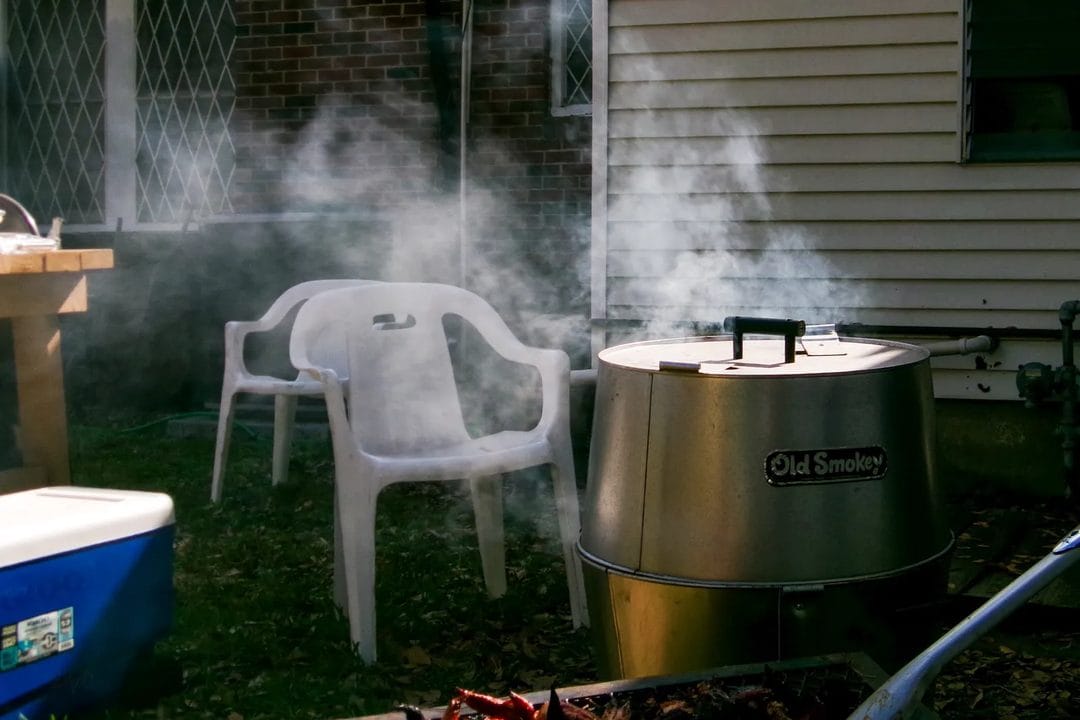
What You're Actually Choosing Between
Somewhere between your third YouTube video and your fifth open browser tab of Amazon reviews, the question stops being "which smoker is objectively the best" and turns into something closer to: how much of your Saturday are you willing to hand over for a plate of ribs? That's the real fork in the road, and almost nobody frames it that way in the store. A salesperson at a Home Depot grill aisle or an Ace Hardware endcap will talk you through hopper capacity and stainless steel gauge, but they won't ask whether you actually want to sit outside babysitting a fire, or whether you'd rather set a target temperature on an app and go mow the lawn.
The three categories worth taking seriously for a first real smoker are the offset (the classic barrel-shaped "stick burner"), the pellet grill (an electric auger feeding wood pellets into a firepot), and the kamado (a thick-walled ceramic or steel egg that grills, smokes, and bakes). Each one asks something different of you before it gives you anything back. An offset asks for your attention, roughly every 30 to 45 minutes, for however many hours the cook takes. A pellet grill asks for a power outlet and a bag of pellets, then mostly leaves you alone. A kamado asks for strong arms to move it and a willingness to relearn airflow management every single cook, because a vent that's dialed in for a 225°F brisket is nowhere close to right for a 650°F pizza an hour later.
The Offset Smoker: Real Smoke, Real Commitment
An offset burns wood or wood-and-charcoal in a firebox set to the side of the main cooking chamber, and heat and smoke pull across the meat before exiting through a stack on the far end. This is the setup you picture when you close your eyes and think "Texas barbecue," and there's a reason for that: it produces a smoke profile that pellet grills and kamados struggle to match, with a thicker bark and a more pronounced smoke ring on brisket and pork shoulder. Entry-level offsets like the Oklahoma Joe's Highland run $400 to $500 and are a genuinely workable starting point once you seal the factory gaps with gasket tape. Step up to an Old Country BBQ Pits Wrangler or a Workhorse Pits model and you're at $900 to $1,800 for noticeably better steel and heat retention. Custom builders like Lang or Gator Pit will run you $3,000 and up, and at that point you're buying a smoker you'll hand down.
What nobody tells first-time buyers is that the sticker price is the cheap part. Running an offset well means tending a fire for the entire cook, adding splits every 30 to 45 minutes, chasing temperature swings of 25 to 50 degrees as the fire burns down and rebuilds, and learning to read smoke color so you're not choking your food in thick white creosote smoke instead of the thin blue smoke you actually want. Expect your first three or four cooks to be genuinely frustrating. If you already know you like being outside, coffee in hand, managing a fire for its own sake, an offset is worth every bit of that learning curve. Skip it if the honest answer is that you want smoked ribs on the table by 6 p.m. without spending your whole afternoon at the smoker.
The Pellet Grill: Convenience That Costs You a Little Bark
A pellet grill loads compressed hardwood pellets into a hopper, and an auger feeds them into a firepot at whatever rate keeps the chamber at your set temperature — you dial in 225°F on a controller or an app, and the machine handles the rest. Traeger's Ironwood and Pro series sit in the $700 to $1,200 range and remain the brand most people recognize; Camp Chef's Woodwind and Pit Boss's Pro series undercut that by a few hundred dollars while offering comparable build quality. Rec Tec's Bull and Trailblazer models cost more upfront but come with heavier steel and controllers that hold temperature within a tighter band, which matters more than it sounds like it should over an eight-hour brisket cook.
- Fill the hopper and set your target temperature before you go to bed if you're doing an overnight brisket.
- A sudden, unexplained temperature drop usually means the auger has jammed, and it happens more with cheap, dusty pellets than premium ones — check there first.
- Clean the grease trap and empty the ash cup after every three or four cooks, or you're inviting a grease fire.
The honest trade-off is smoke intensity. Because pellet grills burn cleaner and cooler than an open wood fire, the bark on a pork shoulder and the smoke ring on a brisket will both be noticeably lighter than what an offset produces, and barbecue purists will tell you a Traeger brisket tastes like a good oven-roasted brisket with a light smoke aftertaste rather than the real thing. That criticism has some truth to it on base models, but it's worth qualifying: higher-end units with a "Super Smoke" or enhanced smoke mode, and the practice of running pellet grills at their lowest stable temperature setting for the first two hours of a cook, close a real chunk of that gap. If your goal is genuinely competition-level bark, buy an offset. If your goal is a very good brisket on a Tuesday without setting an alarm to check a fire at 2 a.m., a pellet grill will get you there with far less effort.
The Kamado: One Grill for Everything, at a Weight Cost
A 200-pound ceramic cooker on a wooden deck, moved there without anyone checking the load rating first, is how you end up in a very different kind of home-improvement article.
A kamado is a thick-walled ceramic (or, on budget models, double-walled steel) egg-shaped cooker that holds heat with startling efficiency because of that mass. The same device that smokes a rack of ribs at 250°F for five hours can sear a ribeye at 700°F twenty minutes later and bake a wood-fired-style pizza the night after that, which is the single biggest argument in its favor for anyone with limited patio space. Big Green Egg's Large model runs about $1,200 for the ceramic body alone, before you add a nest, a shelf, or a plate setter; Kamado Joe's Classic III lands close to $1,400 fully equipped. Char-Griller's Akorn, a double-walled steel kamado rather than ceramic, gets you into the category for around $400, with slightly less heat retention as the compromise.
Airflow is everything on a kamado, and it works nothing like a pellet grill's set-and-forget controller. You're managing a top vent and a bottom vent by hand for every cook, and the ceramic body holds so much thermal mass that overshoots take a long time to correct — crack the vents too far open chasing a stalled temperature and you can blow past your target by 100 degrees before you notice. Ceramic models also don't love rapid temperature swings; going from a cold start straight to a screaming-hot sear can stress the ceramic enough to crack it over time, which is the one real durability weakness against steel offsets and pellet grills. None of that makes the category a bad choice — it makes it the right choice specifically for someone who wants a single grill that does searing, smoking, and baking, and is willing to relearn the vents every time the job changes.
Fuel Costs and Upkeep Nobody Mentions in the Store
The purchase price is only the opening bid. Offsets and kamados both typically run on lump charcoal, which costs roughly $25 to $30 for a 20-pound bag of a quality brand like Royal Oak or Fogo, and a long cook can burn through a full bag plus wood splits on top of it. Pellet grills run on hardwood pellets at $18 to $25 per 20-pound bag for a mainstream brand like Traeger or Bear Mountain, and a typical low-and-slow cook uses one to two pounds of pellets per hour, so an eight-hour brisket runs you $10 to $15 in fuel. Offset owners buying seasoned oak or hickory splits from a local supplier are often paying $50 to $80 for enough wood to get through a weekend of cooking, more if you're buying pre-split kiln-dried wood from a hardware store instead of sourcing it locally.
Maintenance differs by category, too, and it's worth budgeting for from day one. Kamado gaskets wear out and need replacing every two to four years, at $20 to $40 a kit. Pellet grill auger motors and igniter rods are the parts most likely to fail, usually somewhere between year two and year four, and a replacement kit runs $30 to $60 if you're comfortable doing it yourself. Offsets need the most frequent physical upkeep of the three — scraping accumulated creosote out of the chamber every handful of cooks, repainting exposed steel before rust sets in, and replacing gasket tape around the firebox door roughly once a season. None of this is expensive in isolation. It adds up over a few years in a way the sticker price never warned you about.
Which One Actually Fits You
If you already know you enjoy the process as much as the food — the fire tending, the smoke reading, the slow afternoon that turns into an evening — buy the offset, start with an Oklahoma Joe's or similar entry model, and accept that your first few cooks will teach you more than any video will. If what you actually want is reliably good smoked meat on a weeknight without rearranging your schedule around a fire, buy a pellet grill from Traeger, Camp Chef, or Rec Tec and don't feel like you're taking a shortcut — you're making a rational trade of a little bark for a lot of your evening back. And if your patio has room for exactly one grill and you want it to sear steaks on Tuesday, smoke ribs on Saturday, and bake a pizza on Sunday, the kamado is built for exactly that job, ceramic weight and vent-learning curve included.
Buy one $15 leave-in probe thermometer no matter which smoker you end up with — a ThermoWorks Smoke or a similar dual-probe unit — because every one of these three categories can drift 20 to 30 degrees off its dial reading, and the difference between a perfect brisket and a dry one usually comes down to whether you trusted the built-in gauge or your own probe.