The cooler in the garage still has half a case of Shiner from the Fourth, and the backyard smells faintly of last weekend's brisket. That smell is the problem. Everyone treats the smoker like it only earns its keep on a 12-hour cook, so it sits cold from Monday through Friday while you order takeout you don't really want. A pellet grill or a kettle full of lump charcoal can put dinner on the table in the time it takes to watch a ballgame, and the food is better than anything you'd get in a clamshell box.
The cuts that reward a short cook
Brisket and pork shoulder need time because they're armored in collagen that only surrenders past 195°F. Most cuts aren't built that way, and forcing them onto a low-and-slow schedule actually hurts them. Chicken thighs, spatchcocked whole birds, pork tenderloin, and a thick tri-tip all finish between 165°F and 203°F in under three hours, and they take smoke beautifully in that window.
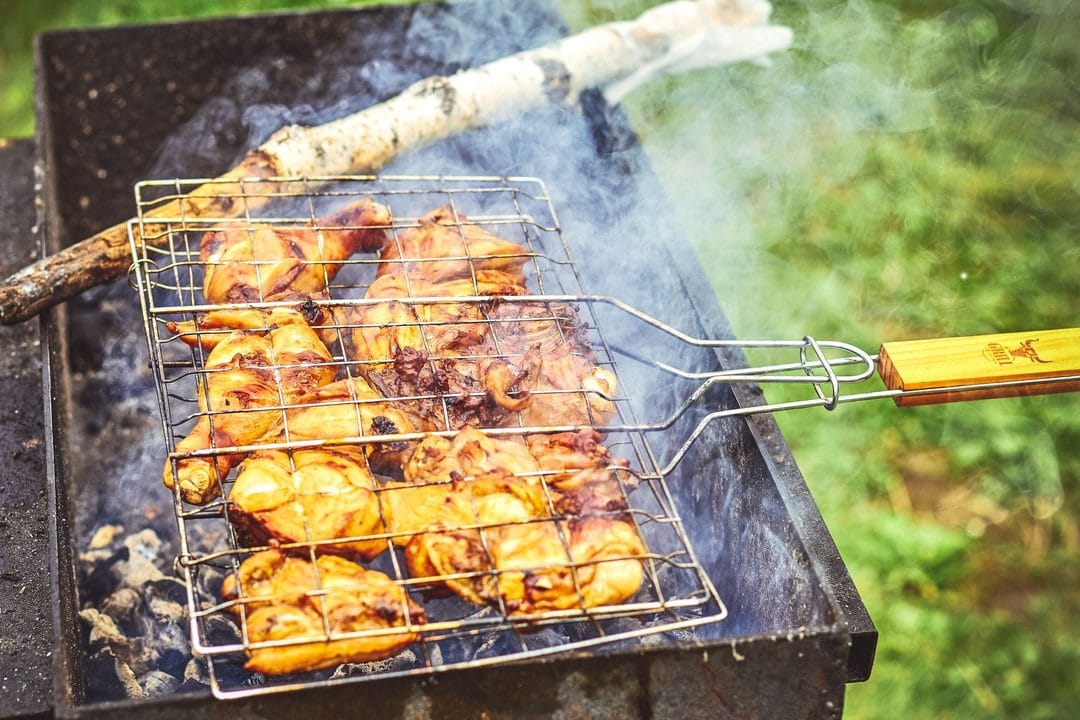
Chicken thighs are the move I'd make nine times out of ten. A pack of bone-in, skin-on thighs runs about $1.49 to $2.29 a pound at most Kroger or Publix stores, the dark meat shrugs off a little overcooking, and the skin crisps up if you run your smoker hot. Set the pit to 325°F — yes, that's hotter than the 225°F gospel you've been fed — and pull them at 175°F internal, roughly 70 minutes in. The collagen in the thigh wants a slightly higher finish temp than a breast, which is exactly why thighs forgive you and breasts punish you.
A tri-tip is the West Coast secret nobody east of Denver talks about
If your butcher counter has tri-tip — and Costco almost always does, around $7 to $9 a pound — buy it. It's a 2-to-3-pound triangle off the bottom sirloin, it smokes to a medium-rare 130°F in about 90 minutes at 250°F, and then you sear it hard over the coals for a crust. Slice it against the grain, and you've got something between a brisket and a ribeye for half the money and a fraction of the babysitting.
Wood matters more than you'd think on a short cook
On a 14-hour brisket, the meat stops absorbing smoke around the four-hour mark, so your wood choice gets diluted across the whole cook. On a 90-minute tri-tip, every chunk you throw on shows up on the plate. That's the part people get backwards.
For poultry and pork, I'd reach for a fruit wood — apple or cherry from a bag of Western or Weber chunks, both easy to find at Lowe's for around $8. They burn mild and sweet, and they won't turn your chicken into an ashtray the way a fistful of mesquite will in that short a window. Save the mesquite and hickory for beef, and even then go light. A common mistake on quick cooks:
- Dumping a full chimney of wood chips on at once, which smolders into acrid white smoke instead of the thin blue you want
- Soaking your chips first — wet wood just steams, then scorches, and you've wasted twenty minutes waiting for it to actually catch
- Opening the lid every ten minutes to "check" — each peek dumps your dome temp and adds time, and on a two-hour cook you don't have time to give back
- Forgetting that pellet grills already meter their own wood, so adding a smoke tube on top can push bitter, oversmoked flavor onto something as delicate as a chicken breast
The gear question, honestly
You don't need a $1,200 offset to do this. A Weber Kettle, the 22-inch one that's been around since the Eisenhower administration and still costs about $230, does a quick smoke as well as anything if you bank the coals to one side and drop a chunk of cherry on top. The convenience play is a pellet grill — a Pit Boss or the entry Traeger Pro runs $400 to $700 — because you set 325°F and walk away, and that set-it-and-forget-it quality is exactly what makes a Tuesday-night smoke realistic instead of aspirational.
Here's where I'll contradict the usual advice, though. A pellet grill is genuinely worse at high-heat searing than a $60 charcoal kettle, so if a hard crust on your tri-tip or chicken skin is the whole point, the cheaper tool wins. I run both: pellet grill for the smoke, then the meat goes onto a screaming-hot kettle for ninety seconds a side to finish. Two pieces of gear that together cost less than one fancy offset, and neither one asks you to wake up at 4 a.m.
A weeknight game plan you'll actually follow
So what does a real Tuesday look like? You get home around 6, light the smoker while you change out of work clothes, and it's at temp by 6:20. Thighs go on with a simple dry rub — kosher salt, coarse pepper, smoked paprika, a little brown sugar — and you're eating by 7:45 with time to spare. No injection, no spritzing every 30 minutes, no foil boat, none of the brisket-day theater.
The leftovers are the quiet payoff. Smoked chicken thighs chopped into a Wednesday quesadilla beat anything from a drive-through, and a few slices of cold tri-tip turn a sad desk-lunch sandwich into something you look forward to at 11 a.m. That's the case for the short smoke: it's not a lesser version of the all-day cook. It's a different, more useful tool, and it's the one that finally gets your smoker off the patio and into your actual week.
Light it on a weeknight once. The garage will smell right again by Thursday.