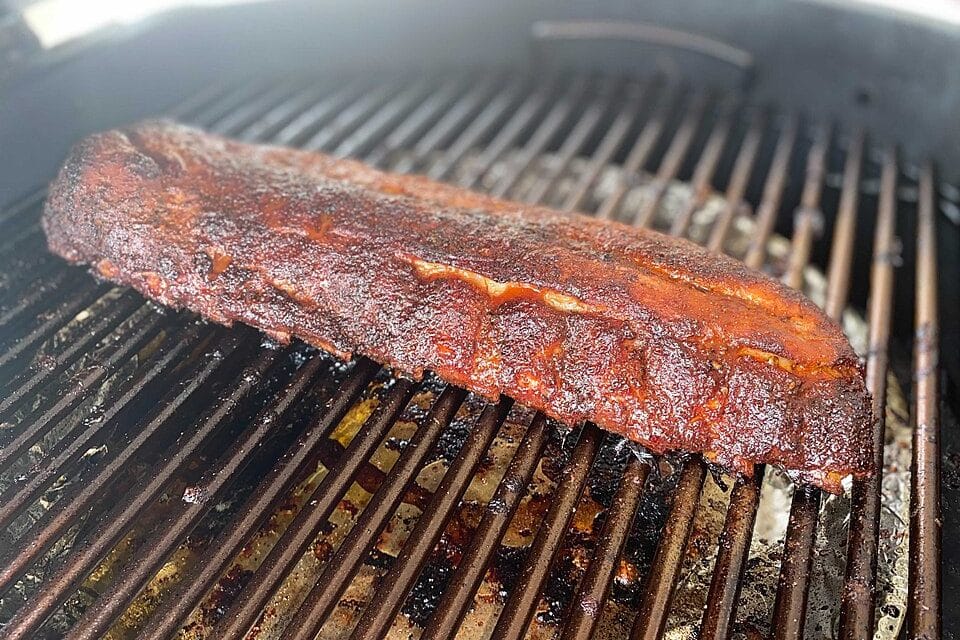
Pull ribs off the smoker one stage too early in a 3-2-1 cook and you'll know within four bites: meat that slides clean off the bone, sure, but bark gone soft as a wet napkin and a puddle of fat where the crust used to be. The 3-2-1 method gets treated like a law of physics on every barbecue forum, and for spare ribs cooked low at 225°F it mostly earns that reputation. Apply the same three numbers to a rack of baby backs, though, and you've built a system for turning a $14 rack of ribs into mush.
What the 3-2-1 Formula Actually Does
The method breaks a rib cook into three phases at 225°F: three hours of unwrapped smoke to build bark and pull in smoke flavor, two hours wrapped tight in foil with a splash of apple juice or a pat of butter to steam the meat tender, and one final hour unwrapped — often with a coat of sauce — to firm the bark back up and let the glaze set. It was built around full spare ribs, the meatier, fattier cut that runs 3 to 4 pounds trimmed St. Louis-style, and on that cut the math genuinely works. Spare ribs carry enough connective tissue and fat to survive two hours of steam without falling apart into strings, and the extra hour unwrapped at the end gives the surface time to re-crisp after all that moisture.
Baby Backs Don't Play by the Same Clock
Baby back ribs come off the loin, not the belly, which means they're leaner, thinner, and done cooking in roughly two-thirds the time a full spare rib needs. Run the same 3-2-1 sequence on a 2-pound rack of baby backs and you'll hit fall-off-the-bone tenderness by the end of the wrap phase — sometimes before it's even over — which leaves that final unwrapped hour with nothing to do but keep cooking meat that was already finished. The result is exactly the mushy, stringy texture people blame on "bad ribs" when the real problem was following spare rib timing on a rack that needed a 2-1-0.5 schedule instead. A better baseline for baby backs is two hours unwrapped, one hour wrapped, and thirty to forty-five minutes back on the grate to set the bark — check doneness at the ninety-minute mark of the wrap phase rather than trusting the full window. Cook temperature matters here too: 225°F is the standard for spares, but nudging baby backs up to 250°F shaves cook time without drying out a cut that has less fat to spare in the first place. Get this wrong once on a Traeger Ironwood set-and-forget program and it's tempting to blame the smoker instead of the timing — the pellet grill did exactly what it was told.
When to Skip the Wrap Entirely
Competition cooks and backyard purists who care more about bark than fall-off-the-bone tenderness often run ribs unwrapped from start to finish — sometimes called "3-2-1 minus the 2," though that name undersells how different the result is. Skip the foil and the ribs never steam, so the surface stays dry enough to build a real crust: dark, slightly tacky, seasoned all the way through instead of soft under a sauce glaze. This method takes longer, usually five to six hours total for spares at 225°F, and it rewards a smoker that holds steady heat without babysitting — a Weber Smokey Mountain 22-inch, running around $400, is close to the gold standard for that kind of unattended stability. The tradeoff is real: unwrapped ribs won't pull clean off the bone the way a 3-2-1 rack does, and diners who grew up on fall-apart barbecue sometimes find the bite-through texture unfamiliar at first.
Read the Meat, Not the Timer
Forget the clock.
The bend test tells you more than any stopwatch: pick up the rack with tongs at one end and let it hang — ribs that are ready will crack slightly at the surface and bend to roughly a 90-degree angle without the meat tearing apart. A probe or toothpick should slide into the meat between bones with almost no resistance, similar to pushing a knife into softened butter, and a ThermoWorks Smoke or a MEATER probe reading 195-203°F in the thickest part confirms it without opening the lid to check. Internal temperature alone isn't the full story on ribs the way it is on a roast — connective tissue needs time as much as heat to break down, so a rack rushed to 203°F over high heat can still come out tough even at the "right" number.
Fixing Mushy Ribs After the Fact
Mushy ribs are almost always a wrap-phase problem: too much liquid in the foil, too long in there, or a rack that never needed the full two hours to begin with. Cut the wrap liquid back to two tablespoons of apple juice or a single pat of butter instead of the quarter-cup pour some recipes call for — that's enough to add moisture without turning the packet into a steam bath. Check the rack at the ninety-minute mark of the wrap phase instead of waiting for the timer, and pull it the moment the bend test passes rather than defaulting to the full two hours. Some cooks skip liquid in the foil altogether and rely on the meat's own rendered fat for moisture, which works fine on a fattier spare rib but leaves a lean baby back rack short on steam. Sugar in the rub matters too — a wrap loaded with brown sugar or honey glaze essentially candies in the foil, and that sticky-soft texture gets mistaken for overcooking when the real culprit was the rub recipe. If the damage is already done and the ribs came off the smoker falling apart, there's a rescue option worth trying:
- Sauce them heavier than usual and finish on a hot grill grate for eight to ten minutes to firm the exterior back up.
- Pull the meat off the bone entirely and serve it as chopped rib meat over cornbread or piled into a sandwich — not elegant, but nobody complains about pulled-rib sliders.
- Chill the rack overnight, then reheat wrapped in a low oven around 275°F, which tightens the meat slightly and pulls the texture back toward bite-through, among other salvage tricks worth trying before writing off the whole cook.
Fixing Dry, Tough Ribs
Dry ribs point to the opposite mistake — usually too little wrap time, too hot a smoker, or a rack pulled before the collagen had a real chance to render. Spare ribs need that internal transformation from tough to tender, and if the bend test still shows resistance, more time is the answer even if the clock says the phase should be over. Wrapping fifteen to twenty minutes earlier than planned, with a slightly more generous splash of liquid than the mushy-rib fix calls for, usually recovers a rack that's heading dry. A loose foil tent during the final rest — ten minutes off heat before slicing — also holds in whatever moisture is left instead of letting it evaporate off the cutting board.
The Gear That Actually Changes the Outcome
None of this timing advice matters much on a smoker that can't hold steady heat, and that's where most backyard rib failures start before the meat even goes on. A drum smoker or a Weber Smokey Mountain holds 225°F within a 10-degree band for hours with minimal adjustment, while cheaper offset smokers can swing 40 degrees or more if the fire isn't tended constantly — and that swing alone can turn a planned 3-2-1 cook into an unplanned 4-1-1 or worse. Pellet smokers like the Traeger Ironwood, at around $1,200, remove the guesswork on temperature stability but make it easier to walk away and forget the ribs are even in there, so pairing one with a leave-in probe thermometer matters more, not less. Heavy-duty foil for the wrap phase runs about $6 a roll and is worth the extra thickness over standard foil, which tears at the corners exactly when you're trying to seal in juice.
A Quick Reference for Both Cuts
Spare ribs (St. Louis-cut, 3-4 lbs): 3 hours unwrapped, 2 hours wrapped, 1 hour unwrapped with sauce, at 225°F — the classic ratio that gave the method its name. Baby backs (2-2.5 lbs): 2 hours unwrapped, 1 hour wrapped, 30-45 minutes unwrapped, at 225-250°F, checked against the bend test rather than the clock. Either way, the foil phase is a tool for hitting a texture target, not a mandatory ritual — skip it, shorten it, or stretch it based on what the rack in front of you is actually doing, not what a formula from a barbecue forum says it should be doing on a rack that might be a different size, a different cut, or a different day's humidity entirely.