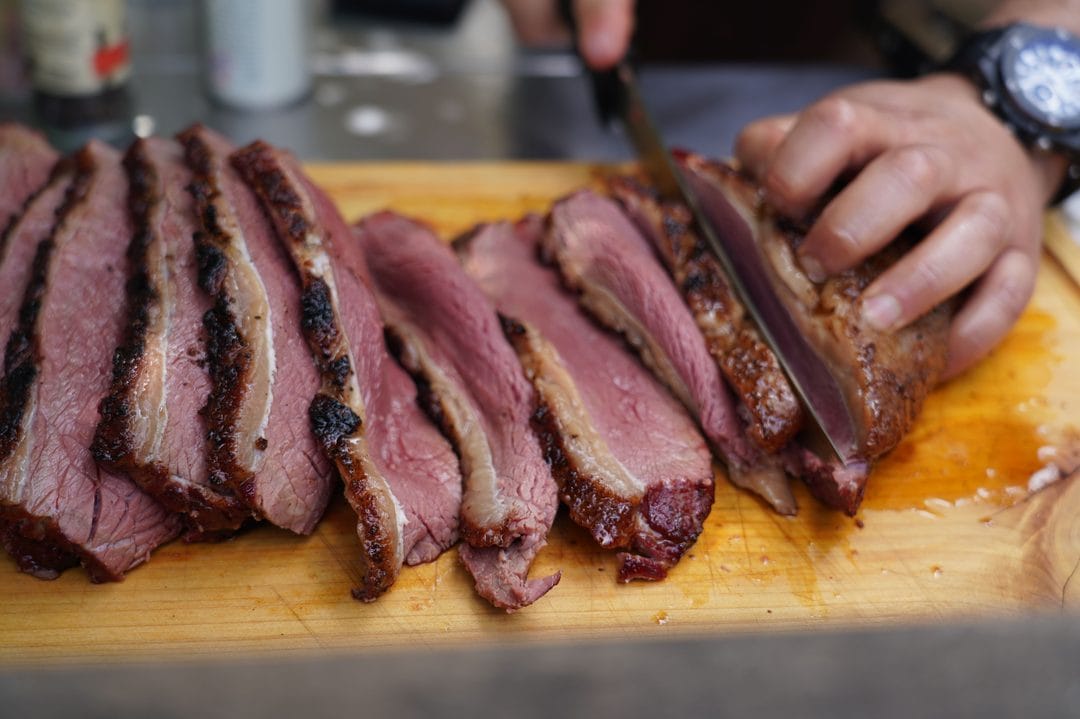
Seven hours into a fourteen-pound packer brisket, the number on the ThermoWorks Smoke display does something that breaks new pitmasters in half: it stops. Not slows down — stops. You were climbing steadily from 40°F to 150°F in a tidy, predictable line, and now the probe reads 158°F at the two-hour mark and 158°F again forty minutes later. The firebox is still running clean at 250°F, the wood is still catching, and the meat is refusing to cooperate. This is the stall, and if you don't understand what's happening inside that brisket, you'll do something you'll regret — usually cranking the vents wide open or yanking the lid to "check on it," both of which make the problem worse.
What the stall actually is
The stall is evaporative cooling, and it works exactly like sweat on your own skin. As the brisket's internal temperature rises past 140°F, moisture inside the meat migrates to the surface and evaporates into the smoker's airflow. Evaporation pulls heat energy out of the meat to convert that surface moisture into vapor — the same mechanism that cools a glass of iced tea sweating on a porch table in July. For a window that typically runs from 150°F to 165°F, the rate of heat loss from evaporation roughly matches the rate of heat gain from your smoker, and the internal temperature holds flat. It isn't stuck. It's in equilibrium.
Not a malfunction — just a twelve-pound piece of meat with a fat cap and a lot of surface area doing exactly what physics demands at that temperature.
Why it lasts longer on some cooks than others
Humidity in the cooking chamber changes how long the stall runs. A bone-dry offset smoker in Amarillo in August pulls moisture off the brisket surface fast, so the stall can drag on for four or five hours. A Weber Smokey Mountain running a water pan, or a Traeger on a muggy Gulf Coast afternoon, has more ambient moisture in the air already, which slows evaporation and can shorten the stall to ninety minutes. Wind matters too — an exposed patio smoker on a breezy day will stall harder and longer than the same cooker tucked against a fence line. None of this means your smoker is broken; it means the stall's length is mostly a function of airflow and humidity, not of anything you did wrong with the rub or the trim.
The Texas crutch: wrapping your way through it
Wrapping the brisket in aluminum foil or unwaxed pink butcher paper once it hits the stall — commonly called the Texas crutch — blocks the airflow that drives evaporation. No air movement across the surface means no evaporative cooling, and the internal temperature resumes its climb almost immediately, often within twenty minutes of wrapping. Foil creates a fully sealed, essentially braising environment: the brisket steams in its own juices, which pushes through the stall fastest but softens the bark you spent six hours building. Butcher paper is more forgiving — it's breathable enough to let some steam escape while still cutting most of the evaporative cooling, so the bark stays firmer while the cook still speeds up meaningfully.
Aaron Franklin popularized pink butcher paper at Franklin Barbecue in Austin specifically because foil was turning his bark to mush, and that's the trade-off in one sentence: foil for speed, paper for bark. If you're feeding people at 6 p.m. and the brisket only hit the stall at 1 p.m., wrap in foil and don't apologize for it — a slightly softer bark beats a brisket that's still at 165°F when your guests are asking where the food is. If you've got the whole day and bark is the point of the exercise, paper is the better call every time.
Riding it out: the patience approach
Skipping the wrap entirely and letting the stall run its course produces the best bark of the two methods, full stop — the surface keeps drying and setting for the entire stall window instead of steaming under wrap, which is why competition brisket teams who prioritize crust almost never wrap early. The cost is time: a fifteen-pound packer that would clear the stall in five hours wrapped might take eight or nine unwrapped, and there's no way to know exactly when it'll break through. You're committing to a longer, less predictable cook in exchange for a shell that shatters slightly when you slice into it, the kind of bark that separates a backyard brisket from a genuinely good one.
What "riding it out" requires from you
This method only works if your fuel supply can outlast the stall, which rules it out on smokers that need constant babysitting to hold temperature — cheap offset units, kettle grills running the snake method, anything where a two-hour nap means a 100°F temperature swing. A pellet smoker like a Traeger or a Weber SmokeFire, or a well-insulated kamado like a Big Green Egg, can hold 250°F unattended for the eight-plus hours an unwrapped stall might demand. Load enough hardwood lump or pellets before you start that running out mid-stall isn't a real risk, because opening the lid to refuel during the stall dumps heat and moisture exactly when the meat can least afford it.
Which one should you actually pick
Wrap in butcher paper if this is a weekend cook with a dinner deadline you actually care about — that's the setup most home cooks are working with, and paper gets you 80 percent of the bark with none of the schedule risk. Skip the wrap entirely if you're smoking on a Saturday with nowhere to be and a smoker that holds temperature reliably overnight; the bark difference is real enough to taste, and an extra three hours costs you nothing when there's no clock running. Reach for foil only when you're genuinely behind schedule, because foil rescues a timeline but it doesn't rescue bark once it's already gone soft and steamed.
A note on temperature targets while you decide: don't wrap the second the probe reads 150°F. Let the bark set for at least an hour into the stall first — mahogany-dark, not just brown, with a surface that feels dry and slightly tacky rather than wet. Wrapping too early locks in a pale, underdeveloped crust no amount of resting will fix later.
Mistakes that make the stall worse
Opening the lid repeatedly to check the brisket is the single most common stall-related mistake, and it's almost always driven by anxiety rather than any real need to look. Every time the lid comes off, the smoker loses heat and humidity, extending the stall and adding cook time you didn't plan for — a rule of thumb among competition cooks is that each lid-open costs roughly fifteen minutes of recovery time at 250°F. Cranking the pit temperature up to "push through" the stall doesn't work either; you'll scorch the exterior before the interior temperature responds, because the stall is governed by evaporation rate, not by how hot your firebox runs. A $14 four-pack of Meat Church Holy Cow rub isn't going to save a brisket that got opened up eleven times in six hours — patience with the lid does more for the final bark than any rub blend on the shelf at Costco.
A little apple cider vinegar and water mist every hour helps bark development before the stall hits, but spritzing heavily during the stall itself is the other trap — it just adds more surface moisture for the smoker to evaporate, which can genuinely extend the flat window rather than shorten it. If you're going to spritz at all, do it before 140°F internal and back off once the temperature curve starts to flatten.
Getting past the stall and to the finish line
Whichever route you take, the number that matters isn't the internal temperature — it's how the meat feels when you probe it. A brisket is done when a thermometer probe slides into the thickest part of the flat with something close to zero resistance, the texture people describe as "probing like butter," which usually lands somewhere between 200°F and 205°F but can vary by a few degrees brisket to brisket depending on fat content and how the animal was raised. Pulling at exactly 203°F because a chart said so, without checking probe tenderness, is how you end up with a brisket that's technically at temperature and still chewy in the point.
Rest it for at least an hour, wrapped in a towel inside a dry cooler, before you touch a knife to it. The stall tested your patience for four or five hours in the middle of the cook — don't undo that by slicing five minutes after it comes off the smoker.