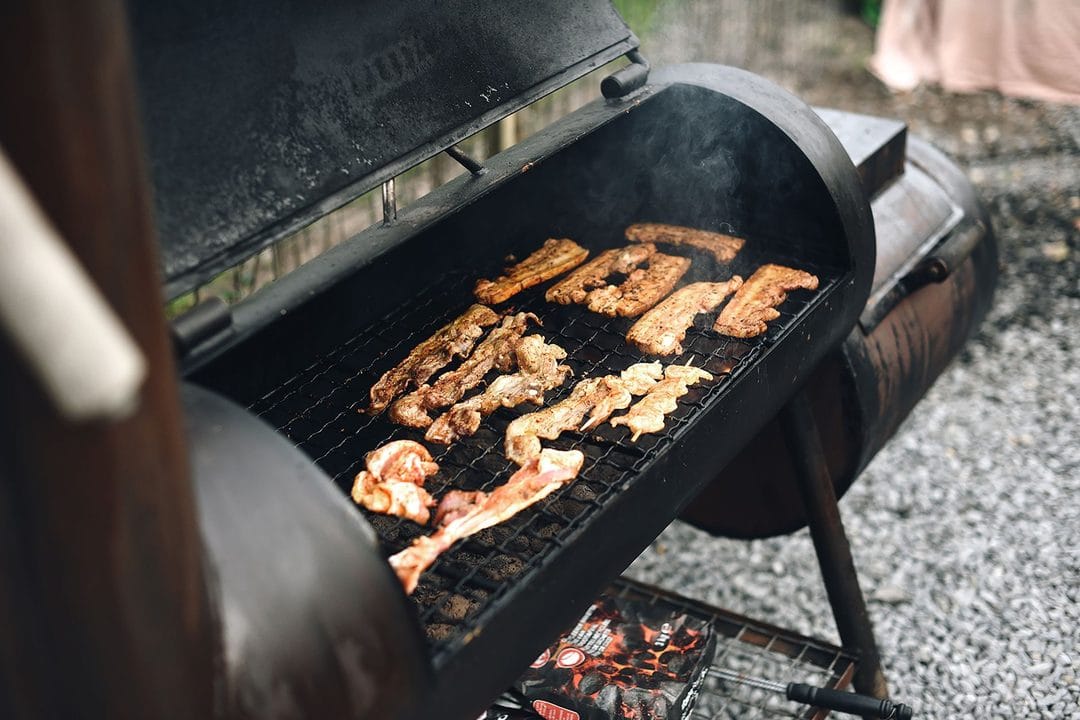
The first 90-degree afternoon of the year is when most backyard cooks discover their smoker has a mind of its own. A rig that held a rock-steady 250°F in April will creep toward 300°F before you've finished your coffee, and cracking the lid to check only makes it worse. Late June is peak season for this headache, and it has almost nothing to do with your fire technique. The air around your cooker is now 30 degrees warmer than the day you dialed everything in.
Why summer heat changes the math
Your smoker doesn't care about the target temperature in your head. It cares about the difference between the cook chamber and the outside air. On a 55°F spring morning, holding 250°F means your fire fights a 195-degree gap and your steel bleeds heat fast. On a humid 88°F afternoon, that same fire only has to cover a 162-degree gap, and the thin metal of a Weber Smokey Mountain or an offset like the Oklahoma Joe's Highland loses heat far more slowly. Same charcoal, same vents, much hotter result.
Direct sun makes it worse in a way the lid thermometer won't tell you. A black smoker sitting in full June sunlight picks up real radiant heat through the body, heat your fire never had to produce. Move that same cooker into the shade of a garage overhang or a patio umbrella and you'll often watch the dome temp drop 15 to 20 degrees within ten minutes, no vent adjustment needed. Shade is the single cheapest temperature-control tool you own, and almost nobody uses it.
Build a smaller fire than you think you need
The instinct in cool weather is to load the charcoal basket full and choke it down. In summer that's a trap. A minion-method setup — a ring of unlit briquettes with a small pile of lit coals dropped in one spot — gives you a slow, rolling burn that's much easier to keep low. Start with maybe a third fewer lit coals than your spring routine. You can always add fuel; you cannot un-burn it.
Fuel choice matters more than people admit. Kingsford Original burns hotter and faster than lump in a way that punishes you on a hot day, while a quality lump like Royal Oak or Jealous Devil settles into a calmer cruise once it's past the initial flare. I run lump almost exclusively from June through August. Briquettes still earn their place on long overnight cooks where the consistent shape keeps the minion burn predictable — it's not a clean win either way.
Vents do the steering, not the lid
Here's the part that trips up newer cooks: in hot weather your intake vent wants to be nearly closed, sometimes down to a pencil-width crack on a Weber Smokey Mountain. That feels wrong. It feels like you're starving the fire. You're not — you're controlling how much oxygen reaches the coals, and oxygen is the throttle. Set the exhaust vent fully open and leave it there; its only real job is to let smoke and moisture escape so your bark doesn't turn bitter. Make every adjustment at the bottom, and make it small.
The other rule is patience. A vent change takes 15 to 20 minutes to show up on the dome thermometer, so if you nudge the intake closed and then nudge it again two minutes later because nothing happened, you've overcorrected and you'll spend the next hour chasing the temperature back down.
Water, ice, and the summer stall
A water pan isn't just for moisture — in summer it's a thermal buffer that flattens swings and keeps spikes from spiking as hard. Some cooks load a foil pan of ice at the start of a hot-weather cook to slow the early ramp-up, then let it boil off into a normal water pan once things settle. That buys you a calmer first hour, which is exactly when most temperature disasters happen.
Expect the stall to behave differently too. When a pork shoulder or a packer brisket hits the 150°F-to-170°F range, evaporative cooling can park the internal temp for hours. On a humid Gulf Coast or Midwest afternoon the air is already saturated, evaporation slows, and your stall can break sooner than it would on a dry day — one of the few ways summer humidity works in your favor.
The thing nobody mentions
Your meat is warmer when it goes on. A brisket pulled from a cooler that's been sitting in an 85°F garage starts closer to the finish line than one that came out of a 38°F fridge in January. That shaves real time off the cook, and if you're working from a winter-tested timeline you'll blow past doneness. Trust the internal probe, not the clock — 203°F in the thickest part of the flat is done whether it took nine hours or six.
- Park the smoker in shade before you light a single coal.
- Start with a third less lit charcoal than your cool-weather routine, and lean on lump over briquettes.
- Intake vent nearly closed, exhaust wide open, and give every adjustment 15 minutes before touching it again.
- Run a water pan; consider starting with ice to flatten the early spike.
- Cook to internal temp, not to a timeline you wrote in February.
Get the fire small and the cooker out of the sun, and a July cook is genuinely easier than a March one — warmer steel, a forgiving stall, and a cold drink that stays cold for more than four minutes.