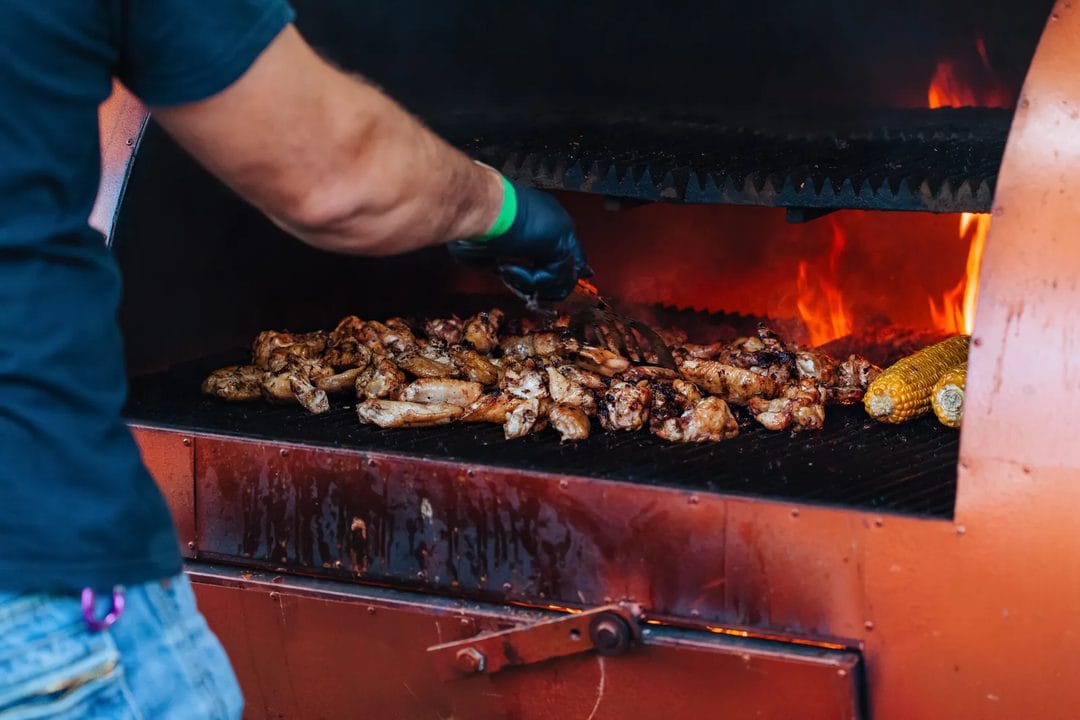
Walk any tailgate lot two hours before an SEC or NFL kickoff and you will see the same mistake over and over: a folding table lined with foil pans of wings that look great and taste like rubber. The pit master ran the smoker at 225°F because that is the number everyone associates with barbecue, and at 225°F chicken skin never renders. It goes on the grate pale and comes off pale, just cooked through and slightly smoky, with a layer of fat sitting under the skin like a wetsuit. Wings are not brisket. They do not reward patience the same way, and treating them like a ten-hour cook is the single most common reason home smokers give up on them and go back to the deep fryer.
Why Wings Punish a Low-and-Slow Setup
A whole chicken thigh has enough mass to render its fat slowly over several hours without drying out the meat underneath. A wing does not. The drumette, flat, and tip together weigh maybe 3 to 4 ounces, and the meat-to-skin ratio is the highest of any cut on the bird. Run a smoker at 225–250°F and the skin sits in that stall zone — warm enough to soften the fat but never hot enough to actually crisp the collagen — for the entire cook. By the time the internal temperature clears 165°F, you have flabby skin wrapped around meat that is already past its best moisture point.
This is the same rendering problem that shows up with smoked chicken thighs, just worse, because there is less meat volume to buffer the mistake. The fix is not a different wood or a fancier rub. It is running the smoker considerably hotter than a brisket or pork butt cook — a point that surprises people who assume "smoked" always means "low and slow."
Set the Smoker to 275–325°F, Not Barbecue Temperature
For crispy skin without a fryer, run the chamber at 275–300°F on a pellet grill (a Traeger Ironwood or a Weber SmokeFire both hold this range steadily) or 300–325°F on a kamado like a Big Green Egg, where the ceramic mass makes high heat easy to sustain without babysitting the vents. An offset smoker can do it too, but you will be feeding the firebox more often than you would for a 225°F brisket cook, so budget an extra split of wood every 30–40 minutes. Skip anything under 275°F for wings. Full stop.
At this range, a batch of 20–24 wings takes 45 to 60 minutes to hit 175–180°F internal — yes, higher than the USDA's 165°F minimum, because wings have enough connective tissue in the joints that pushing past 165°F actually improves texture rather than drying the meat out, the same logic that applies to dark meat on a smoked turkey.
Dry Brine and Baking Powder Do the Real Work
Temperature gets the skin to render, but the crispness people associate with a deep fryer comes from moisture removal before the wings ever touch heat. Pat the wings fully dry, then toss them in a mix of 1 tablespoon kosher salt, 1 teaspoon baking powder, and 1 teaspoon of your favorite dry rub per pound of wings. The baking powder — not baking soda, which leaves a metallic aftertaste if you use too much — raises the surface pH and breaks down proteins in the skin, which lets more moisture escape during the cook. Spread the wings on a wire rack over a sheet pan and refrigerate uncovered for at least 4 hours, ideally overnight.
- Skip the rack step and skip the dry time, and you will get smoky wings with decent flavor but soft skin — still better than a 225°F cook, but not the shattering crackle you are after.
- A dry rub heavy on sugar (many competition rubs are) will burn before the skin fully crisps at 300°F+; save sugary rubs for ribs and pork shoulder, and lean savory here — smoked paprika, garlic powder, black pepper, a little cayenne.
- Buffalo Wild Wings dusts with cornstarch before frying for the same reason restaurants use it on Chinese-style fried chicken — it is the same chemistry as the baking powder trick, just a different mechanism.
The Finish: A Hot Sear Beats a Longer Smoke
Here is the part most backyard cooks skip. Pull the wings at 175–180°F internal, then move them directly over the hottest part of the grate — or, on a pellet grill, crank it to its max sear setting if it has one — for 3 to 5 minutes per side. This final high-heat blast is what separates "smoked wings" from "wings that were also near a fire." It is the same reverse-sear logic used on a thick pork chop or a steak, just inverted: cook low(er) first for even doneness, then finish hot for the crust.
No sear station on your smoker? A cast iron skillet set directly on the smoker grate over the firebox works, or finish under a kitchen broiler for 2 minutes a side once you bring the wings inside. Either way, do not skip this step and expect fryer-level crunch — it will not happen from smoke heat alone, no matter how long you leave them on.
Wood Choice: Lighter Than You Think
Wings spend less time in the smoke than a 12-hour brisket, so the wood you choose matters more per minute, not less. Hickory and mesquite, both popular for beef, turn bitter on poultry skin if you run a full hopper of either — the short cook time means the smoke ring forms but the acrid compounds that would normally mellow over hours do not get the chance. Apple, cherry, and pecan are the better call for wings: mild, slightly sweet, and forgiving if you overshoot the smoke exposure by 10 minutes. If mesquite is all you have on hand, cut it 50/50 with a fruit wood rather than running it straight.
Sauce Strategy for a Tailgate Crowd
Toss wings in sauce right after the sear, while the skin is still hot enough for the sauce to cling without going soggy on the drive to the parking lot. For a tailgate spread that needs to survive a cooler and a folding table for three or four hours, put sauce on the side in squeeze bottles instead of tossing everything in advance — the wings hold their crunch and people can build their own plate.
Four regional directions worth having in rotation, none of which requires more than a saucepan:
- Classic Buffalo — Frank's RedHot and melted butter, roughly 2:1, whisked warm.
- Nashville hot — cayenne bloomed in hot bacon fat or lard, brushed on after the sear, not before.
- Alabama white sauce — mayonnaise, apple cider vinegar, black pepper, and a little horseradish, more common with smoked chicken than wings but it works.
- Kansas City-style — a molasses-and-tomato sauce brushed on in the last 5 minutes of the sear so the sugar caramelizes instead of scorching.
How Many Wings, and What They Cost
Plan on 6 to 8 whole wings per person if wings are the main event, or 4 to 5 if they are one of several dishes on the table alongside burgers or a smoked pork shoulder. For a group of 20 at a September tailgate, that is roughly 15 to 18 pounds of whole wings — figure $2.50 to $4.00 per pound depending on region and whether you buy pre-cut party wings (drumette and flat separated) or whole wings you section yourself. Sectioning your own saves $0.50 to $1.00 a pound at most grocery chains and only adds about 15 minutes of prep for that quantity, which is a trade worth making the night before rather than the morning of.
A pellet grill or kamado in the 275–300°F range can comfortably hold 40–50 wings across two full racks in one batch, which matters if you are cooking for a full parking lot and not just your own tailgate. Stagger two batches 20 minutes apart rather than overcrowding a single load — overcrowded wings steam each other and you lose the crisp you spent all that prep time chasing.
What to Skip
Do not wrap wings in foil at any point in this process — that is a brisket and pork butt technique meant to push through the stall, and wings never stall the way a 10-pound cut does. Do not brine them in liquid the way you would a turkey; the added surface moisture works directly against the dry-brine crisping you are trying to achieve. And do not trust a meat thermometer probe placed near the joint — the reading runs hot there by 5 to 10 degrees because of the bone. Probe the thickest part of the flat instead, away from any bone, for a number you can actually rely on when the tailgate crowd is hungry and asking when the wings are ready.