The brisket's been resting under foil for forty minutes, the ribs are stacked and glistening on a cutting board, and the yard smells like a campfire that learned how to cook. Then someone opens the cooler, pulls out a bag of chips, and asks what's for sides. If the answer is a tub of potato salad grabbed on the way over, you've spent fourteen hours running a smoker capable of real output and served the results with an afterthought. The sides are not a footnote to a cookout. Done right, on the same smoker, at the same time, they're half the meal.
That's the part most backyard pitmasters skip. They'll rattle off wood choices and internal temps for a pork shoulder without blinking, then hand the beans job to whoever's willing to open a can. It doesn't have to be that way, and it doesn't take much more effort. Baked beans, mac and cheese, and corn all take well to smoke, and all three can ride on the same rig that's already cooking your protein — no extra charcoal, no second cook, no reason to leave money on the table when the smoker's already lit.
Smoked Baked Beans: Skip the Can-Straight-Up Route
Canned beans smoked for two hours taste better than most from-scratch versions that skip the smoker entirely — that's not a hedge, that's the actual result of doing it both ways. Start with a 28-ounce can of Bush's Original, drain about half the liquid, and dump the rest into a disposable aluminum pan along with a chopped half-onion, a quarter cup of brown sugar, two tablespoons of yellow mustard, and a splash of apple cider vinegar to cut the sweetness. Chopped bacon on top isn't optional. Four strips, raw, laid across the surface before the pan goes on the smoker, render down and baste the beans the whole time they cook.
Set the smoker to 250°F and give the beans two hours, uncovered, positioned on a lower rack if you're running a brisket or pork shoulder above them — the rendered fat that drips down adds more flavor than any rub could. Stir once at the one-hour mark so the top doesn't scorch, and pull them when the liquid has thickened to a glaze rather than a soup. If you're feeding a crowd of more than eight, double the recipe rather than trying to stretch one can; thin beans spread across too many plates read as an afterthought no matter how good the smoke flavor is.
Doctoring the Can Without Pretending It's Homemade
Some cooks will tell you real baked beans start with dried navy beans soaked overnight and simmered for hours before they ever see smoke. Fine — if you've got that kind of morning to spare. Most people running a smoker on a Saturday are already juggling a brisket that went on at 4 a.m. and don't need a second all-day project. Bush's, Van Camp's, or a store-brand equivalent from Kroger or Publix (usually $2.29 to $2.79 a can) gets you 90 percent of the way there, and the smoker does the rest. Add a spoonful of brisket trimmings or pulled pork bark if you have it on hand — that's the move that separates good smoked beans from great ones, and it costs nothing extra since you're already cooking the meat.
Smoked Mac and Cheese: Where Ambitious Pitmasters Go Wrong
This is the side that most often gets ruined by good intentions.
The mistake is treating smoked mac and cheese like a low-and-slow cook the way you'd treat a brisket, leaving it on for three or four hours because "more smoke equals more flavor." It doesn't work that way with dairy. Cheese sauce left over heat for that long breaks, separates, and turns grainy no matter how careful the roux was. Ninety minutes at 225°F to 250°F is the ceiling — long enough to pick up real smoke character, short enough that the sauce stays glossy and the pasta doesn't go mushy. Cook your elbow macaroni or cavatappi to just shy of al dente on the stovetop first, since it'll keep cooking in the smoker.
Build the cheese sauce the normal way: a butter-and-flour roux, whole milk, then a blend of sharp cheddar and gruyère folded in off the heat so it doesn't seize. Combine with the pasta in a disposable aluminum pan, and hold off on any breadcrumb topping until the last twenty minutes — panko tossed with melted butter, scattered over the top, gives you a crust without burning. Skip pre-shredded bags of cheese here; the anti-caking cellulose coating on that stuff keeps it from melting smoothly, and a $6 block of Cabot extra-sharp cheddar you shred yourself makes a visibly better sauce than a $4 bag ever will.
Cheese Choices That Actually Melt
- Sharp cheddar (Cabot or Tillamook) for backbone and color
- Gruyère or fontina for stretch and a nuttier finish
- A small handful of smoked gouda if you want the smoke flavor doubled down, though it's easy to overdo — a quarter pound is plenty for a full pan
- Avoid pre-shredded blends entirely, and don't reach for processed cheese product no matter how creamy the label promises it'll be
Smoked and Grilled Corn: Two Ways That Both Work
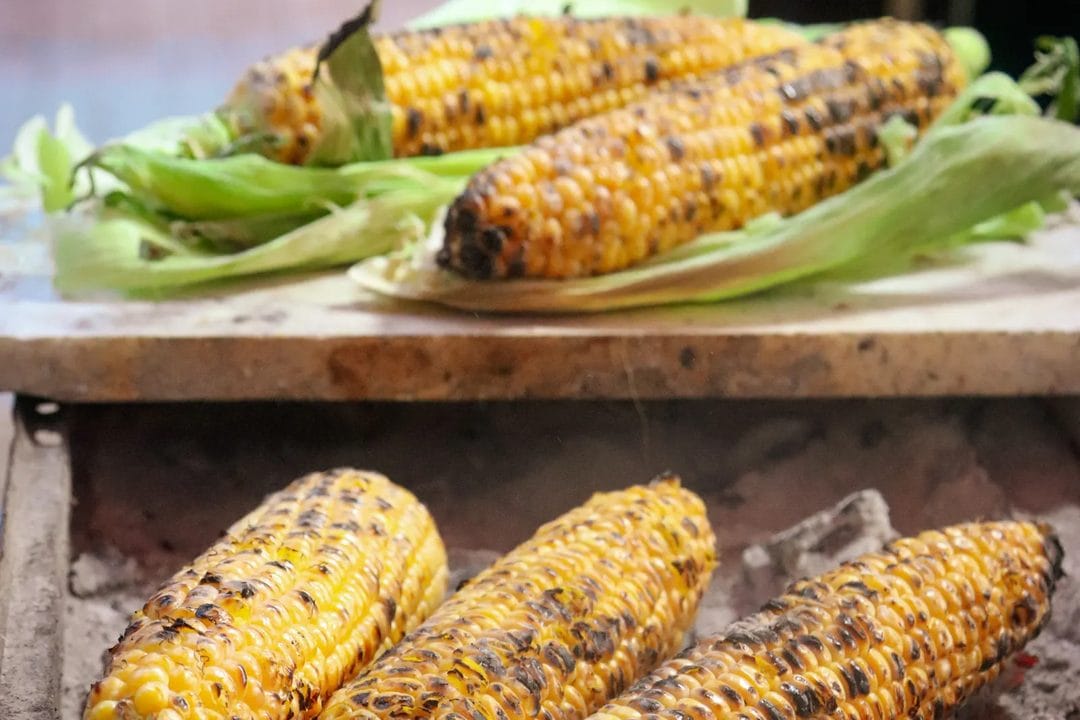
Corn is the side that scales easiest, and it's also the one people most often just boil and forget. Don't. For the smoker version, shuck the ears completely, brush with softened butter, and give them 45 minutes at 250°F directly on the grate, turning once halfway through. The kernels pick up a light smoke ring and stay juicy, which plain boiled corn never manages. Six to eight ears fits comfortably alongside a mac and cheese pan without crowding either one.
The other route is Mexican street corn, or elote, and it's the one that actually gets people talking at a cookout instead of just eating quietly. Grill the ears hot and direct for char, then slather with a mix of mayonnaise (real mayo — Duke's or Hellmann's, not a low-fat substitute that breaks under heat) and a little sour cream, roll in crumbled cotija cheese, dust with Tajín or chili powder, and finish with a squeeze of lime. It's messy, it's not traditional cookout fare, and it's exactly the kind of side that gets someone asking for the recipe before they've finished the ear.
Elote-Style for a Crowd That Wants Something Different
Cotija runs about $5 to $6 for an 8-ounce block at most grocery stores with a Latin foods section, and it keeps for weeks in the fridge, so there's no reason not to have it on hand once you've made elote once. If cotija isn't available locally, feta is the closest substitute in texture and salinity — not queso fresco, which is too mild and doesn't crumble the same way.
Timing It All Against the Protein
The logistics matter more than any individual recipe. If brisket goes on the smoker at 4 a.m. and comes off around 4 p.m., the beans go on at 2 p.m., giving them their full two hours while the brisket rests. Mac and cheese follows at 2:30, finishing right as the meat gets sliced. Corn is the last thing on, at 3:15, since 45 minutes puts it done at exactly the moment everyone's plate is ready. Ribs run a shorter overall cook — five to six hours — so if ribs are the headline protein, shift everything back accordingly and start the beans about two hours before the ribs come off.
None of this requires a second smoker or a complicated schedule. It requires knowing that beans need two hours, mac and cheese needs ninety minutes and no longer, and corn needs forty-five, and working backward from when you actually want to eat. Write the three times on a sticky note and put it on the smoker lid if you have to — nobody's going to judge you for it, and everyone's going to notice when the sides come out at the same time as the meat instead of twenty minutes late while the brisket goes cold.
Which Side Goes With Which Meat
Pulled pork wants baked beans — the sweetness and the vinegar tang echo the pork's own glaze, and it's the pairing you'll find at just about every real barbecue joint from the Carolinas to Kansas City. Brisket wants mac and cheese, since the richness of the cheese sauce balances the leaner, more mineral flavor of beef rather than competing with it. Ribs want corn, plain and simple, because the char and sweetness cut through the richness of the rub and the sauce without adding another heavy, cheese-forward element to the plate.
That's not the only combination that works, and plenty of good cookouts put all three sides out regardless of what's on the smoker. But if you're only making one side because time or space is tight, match it to the protein doing the heavy lifting that day. A pan of smoked beans sitting next to a rack of ribs is fine. A pan of smoked beans sitting next to pulled pork is the whole point.
Next time the smoker's already running for six or eight hours anyway, put one of these three sides on the lower rack and stop treating them as an afterthought. The beans alone, with four strips of bacon and two hours of smoke, will get emptied before the meat does.