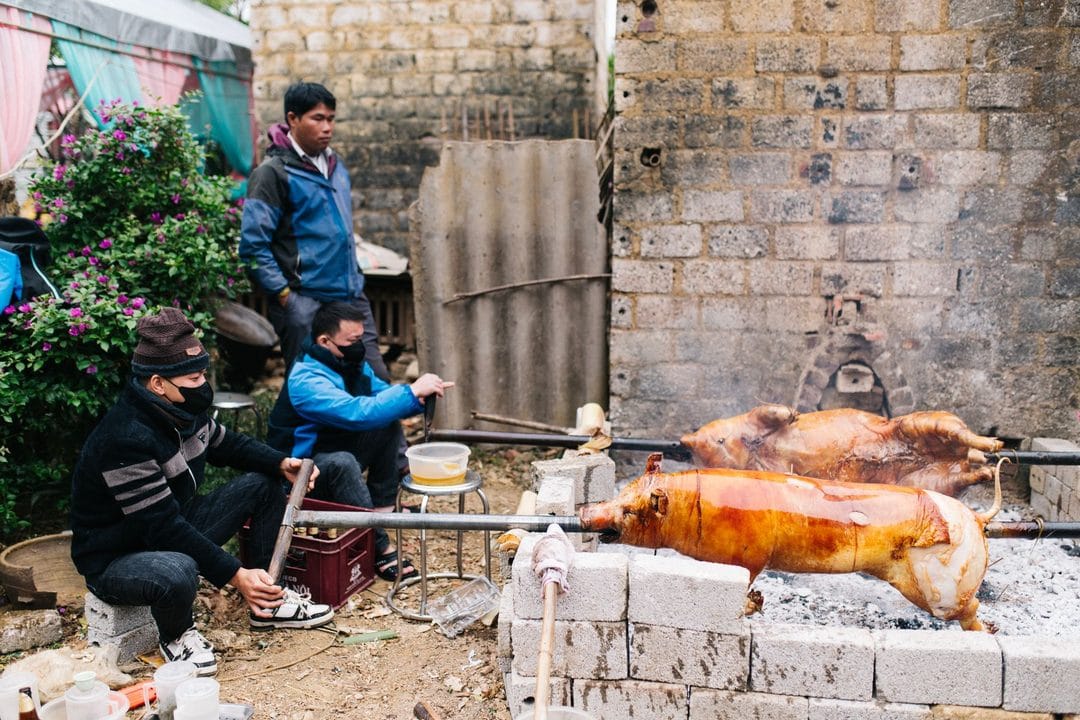
Call a whole-animal farm in early August about a hog for Labor Day and you'll usually still get a yes. Call the week after next and there's a real chance the answer is "we're sold out through September" — small farms that raise pasture hogs to order don't keep extras sitting around, and Labor Day weekend is the single biggest whole-hog cooking weekend of the year outside of a handful of competition circuits. If a whole hog has been on your list, this is the week to make the call, not the week before the holiday.
What a whole hog actually costs, region by region
A market-weight hog in the 180–220 lb live-weight range runs $2.75–$3.50 per pound hanging weight from most small farms and processors, which puts a finished, dressed hog for the smoker somewhere between $400 and $600 depending on your region and whether the farm does the slaughter and dressing in-house or sends it to a third-party processor. Farms in the Southeast and Texas tend to sit at the lower end of that range because hog farming is denser there and competition keeps prices down; farms in the Northeast and Pacific Northwest run higher, sometimes $700–$800 for a comparable animal, partly because of processor scarcity and partly because pasture-raised operations out there lean smaller and charge accordingly. A dressed 180 lb hog feeds roughly 90–110 people once you account for bone, fat rendering off during the cook, and the standard estimate of half a pound of finished pulled pork per adult serving — numbers worth having in hand before you commit to a size, because going from a 150 lb hog to a 220 lb hog adds real cost without proportionally more usable meat once you factor in the extra cook time and fuel.
Lead time is the part people underestimate
Most small farms need two to four weeks of notice for a whole hog, and that window gets shorter fast once you're within ten days of any major grilling holiday — Memorial Day, Fourth of July, and Labor Day all create the same bottleneck. The farm itself usually isn't the constraint; the processor is. USDA-inspected or state-inspected slaughter facilities book up around holiday weekends because every whole-hog customer within driving distance wants their animal processed the same week, and a facility that can normally turn an order around in three days might be quoting ten during the last two weeks of August. Calling now, with three and a half weeks of runway before Labor Day, still gives the farm room to book a processing slot without rushing it — call the Wednesday before the holiday and you're negotiating around whatever's left, not what actually fits your timeline.
Whole hog versus pork shoulder: the real cost-per-serving math
It's tempting to assume a whole hog is the expensive, showy option and shoulders are the budget move, but the math is closer than most people expect. Bone-in pork shoulder runs $2.29–$3.49 per pound at most grocery chains this time of year, and a 9 lb shoulder yields around 5–5.5 lbs of pulled pork after trimming and the standard 40% cook-down — call it $18–$25 in meat cost per finished pound. A whole hog at $500 dressed, yielding roughly 60% of hanging weight as usable pulled meat once skin, bone, and rendered fat are accounted for, works out closer to $10–$12 per finished pound of pork — genuinely cheaper per serving, before you even count the loin, ribs, and belly you get as a bonus that shoulder-only cooking never delivers. The catch is volume: that math only pays off if you're actually feeding 80-plus people, because a half-eaten hog doesn't freeze and reheat the way pulled shoulder does, and there's no polite way to store forty pounds of leftover roasted pig in a home freezer.
The cook itself: what changes at whole-hog scale
A whole hog in the 180–200 lb range needs 12–16 hours on an offset or a dedicated hog cooker running 225–250°F, split-side down for most of the cook and flipped skin-side up for the final ninety minutes to crisp the skin — a very different rhythm than a shoulder, which you can walk away from for stretches. Whole-hog cooking demands someone checking the fire every 45 minutes to an hour for the entire cook, which in practice means either an overnight shift rotation between two or three people or renting a trailer-mounted hog cooker with a built-in firebox that holds temperature more forgivingly than an open pit. Renting one of those rigs runs $75–$150 for a weekend from most party-rental companies or barbecue supply shops, and it's worth it the first time you attempt this — babysitting an open cinder-block pit through a Southern August night is a different kind of commitment than most home cooks have signed up for.
What to ask the farm when you call
Confirm live weight versus dressed weight up front, since quotes sometimes get given in one and assumed in the other, and a 200 lb live hog dresses out closer to 145–150 lbs after slaughter — a gap that catches first-timers off guard when the delivered animal looks smaller than expected. Ask whether the processor will butterfly and remove the backbone, known as "spatchcocking" the hog, which most whole-hog cookers actually prefer because it lets the animal lie flatter and cook more evenly than a hog left whole with the spine intact. And ask about pickup timing relative to the cook: a hog picked up more than 48 hours before it goes on the smoker needs proper refrigeration space most home kitchens don't have, so timing the pickup for the morning of or the evening before the cook usually works better than trying to store it days in advance.
If a full hog is too much: the half-hog option
Not every gathering needs 90-plus servings, and a growing number of farms will sell a hog split lengthwise into halves specifically for this reason — one half goes to your cookout, the other to a neighbor or a second household splitting the order. A half-hog runs roughly $250–$350 depending on the same regional pricing that applies to the whole animal, feeds 40–55 people, and cooks in 8–10 hours instead of 12–16, which brings the fire-tending commitment down to something a single dedicated person can realistically manage without an overnight shift. The trade-off is presentation: a half-hog doesn't get the same table-centerpiece moment as a whole animal laid out skin-side up, and some processors charge a modest splitting fee, usually $30–$50, on top of the per-pound rate. For a Labor Day gathering of 40–50 people rather than a full block party, it's worth asking the farm about this option specifically — most won't offer it unless you ask, since whole-hog orders are simpler for them to process.
Permits and where you're allowed to cook
An open-pit or trailer-mounted hog cooker running for 12-plus hours produces enough smoke and open flame that a handful of counties and HOAs require a temporary burn permit or at minimum a heads-up to the local fire marshal, particularly in states with active burn bans during dry late-summer stretches. A quick call to the county extension office or fire department — five minutes, usually free — confirms whether your specific setup needs paperwork, and it's a far better conversation to have in mid-August than to have a cook shut down mid-smoke because a neighbor called it in. Cooking on private rural land rarely triggers this at all; cooking in a subdivision or anywhere with an active burn ban due to drought conditions is where it actually matters.
Not every backyard is set up for this, and that's fine — a whole hog rewards a crew, a permit check with the county if you're cooking somewhere semi-public, and a farm relationship built before the holiday rush hits. But if the idea has been sitting on a list for a year or two, Labor Day with three weeks of lead time is about as good a window as the calendar offers. Make the call this week, confirm the processing slot, and the rest of the planning falls into place around a date that's already locked in rather than a date you're still hoping works out.