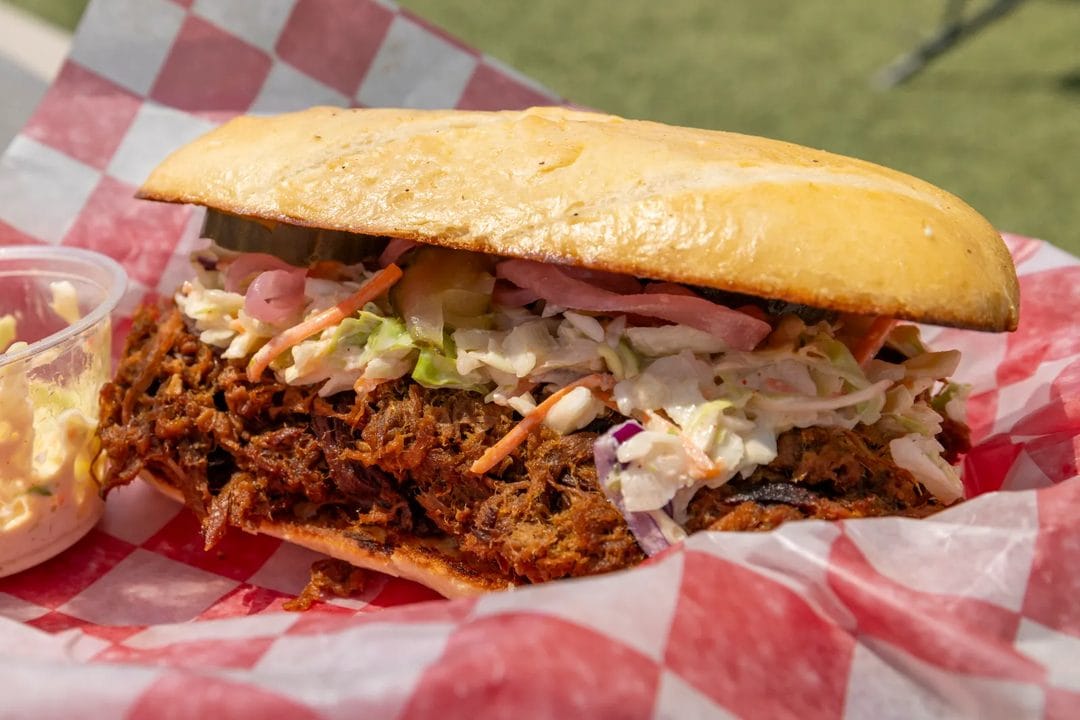
The pork has been resting under foil for twenty minutes, the bark has gone soft and glossy where the juices soaked back in, and you're standing at the counter with two forks wondering what happens next. Pulling the meat is the easy part. Feeding forty people off one shoulder without the line backing up into the yard, without the buns going soggy by noon, without someone standing there holding a paper plate because there's nowhere to set the mustard sauce down — that's the part nobody plans for until the first guest shows up hungry. Most hosts spend three days thinking about the smoker and twenty minutes thinking about the table, and it shows the moment the crowd arrives. The buns go stale because nobody toasted them. The one bottle of sauce runs out by the second wave of guests, and latecomers get plain pork on a cold roll. None of that is a smoking problem — it's a logistics problem, and logistics problems have straightforward fixes if you plan them the same way you'd plan the cook itself.
A sandwich bar isn't just pork and buns on a table. It's a sequence: bread that can hold up to sauce without collapsing, three or four sauces that actually taste different from each other instead of three bottles of the same red stuff, a holding setup that keeps eight pounds of meat moist for three hours in August heat, and a topping lineup that doesn't require someone to explain what "Alabama white" means to a cousin who just wants ketchup. Get the sequence right and the line moves. Get it wrong and you spend Labor Day playing short-order cook instead of eating your own barbecue.
Picking a Bun That Survives Contact With Sauce
King's Hawaiian sweet rolls are the default at most backyard cookouts, and they're a mistake for pulled pork specifically. The 12-pack runs about $5.99 at most grocery chains, they're soft enough to fall apart under a ladle of Carolina vinegar sauce, and their sweetness fights with a mustard-based sauce instead of complementing it. Save the Hawaiian rolls for sliders with a dry rub and no sauce at all.
Martin's Potato Rolls are the better call for a sandwich bar, and it's not close. A bag of 12 costs around $4.29–$4.99 depending on your store, the crumb is dense enough to soak up sauce for a solid two or three minutes before it starts to give, and the slight sweetness balances vinegar-forward sauces without overpowering them. Toast them cut-side down on a griddle or in a 350°F oven for four minutes before serving — this single step is the difference between a bun that holds together through a napkin-free bite and one that becomes a fork-and-plate situation halfway through.
Brioche buns look right on a farm-table spread but they're the wrong texture for this job: too rich, too soft, and priced at $1 to $1.50 each from most bakeries when you'd need thirty or more. If your crowd genuinely prefers a brioche bite, buy the sturdier bakery-style brioche burger buns rather than the pillowy dinner-roll version — they toast better and won't turn to paste under a wet sauce.
How Many Buns to Buy
- Plan on 1.5 buns per adult if this is the main event of the meal, not 1 — people go back for seconds more often than hosts expect
- A 12-pack of Martin's covers 8 people comfortably with a bun to spare
- Buy 10% extra beyond your headcount math and freeze what's left; potato rolls hold up fine in the freezer for a month, unlike Hawaiian rolls, which go gummy
Four Sauces, and Why You Need More Than One
Setting out a single bottle of store-bought barbecue sauce tells your guests this is a casual weeknight dinner. Setting out four distinct styles, each in its own labeled bowl with its own spoon, turns the sandwich bar into the centerpiece of the party — and it costs almost nothing extra since three of the four take five minutes to make from pantry staples. Vinegar-based, tomato-sweet, mustard-forward, and mayonnaise-based sauces come from four separate barbecue regions, and each one changes the sandwich into something different rather than just adding more of the same red flavor on top. A vinegar sauce cuts through the fat in the shoulder the way lemon cuts through fried fish. A mustard sauce adds a sharpness that plain tomato sauce can't touch. White sauce, which reads strange to anyone who grew up outside Alabama, tastes like a barbecue sauce and a remoulade had a baby, and it wins over skeptics faster than any of the others once they actually try it. Set all four out in a row with tongs and small bowls, not squeeze bottles, so guests can layer more than one on the same sandwich if they want to.
Carolina Vinegar Sauce
Whisk 1 cup apple cider vinegar, 2 tablespoons brown sugar, 1 tablespoon red pepper flakes, 1 teaspoon salt, and 1 teaspoon black pepper. No cooking required — it just needs 20 minutes to let the sugar dissolve. This is the sauce that cuts through fat, and it's the one you toss the pulled pork in directly before it ever hits the bun.
Kansas City Sweet
Combine 1 cup ketchup, 1/3 cup molasses, 3 tablespoons brown sugar, 2 tablespoons apple cider vinegar, 1 tablespoon Worcestershire sauce, and 1 teaspoon smoked paprika in a saucepan, then simmer 10 minutes until it thickens slightly. Sweet Baby Ray's works fine as a shortcut base if you're short on time — doctor it with a splash of vinegar and a pinch of cayenne so it doesn't taste like it came straight from the bottle.
Carolina Gold Mustard Sauce
Whisk 3/4 cup yellow mustard, 1/4 cup apple cider vinegar, 3 tablespoons brown sugar, 1 tablespoon Worcestershire sauce, and 1/2 teaspoon cayenne. This is the sauce that gets ignored on the table until someone tries it and then quietly takes the whole bowl back to their seat.
Alabama White Sauce
Mix 1 cup mayonnaise (Duke's, if you can find it — the tang matters here), 1/4 cup apple cider vinegar, 1 tablespoon coarse black pepper, 1 teaspoon horseradish, and 1/2 teaspoon garlic powder. This one belongs on smoked chicken as much as pork, and it's the sauce that surprises people who assume white sauce means ranch dressing.
Label each bowl. Half the point of a four-sauce bar disappears if guests can't tell mustard sauce from Carolina Gold at a glance, and nobody wants to ask.
The Topping Bar: Fewer Options, Better Execution
A topping bar with nine mediocre options is worse than one with four good ones. Skip the shredded lettuce and tomato slices — they're filler, not flavor, and they make the sandwich fall apart faster.
- Vinegar slaw — thinly sliced cabbage, apple cider vinegar, a touch of sugar, celery seed, no mayonnaise. This is non-negotiable on a pulled pork sandwich; the acid and crunch do work the meat can't do alone.
- Bread-and-butter pickles — Mt. Olive or Wickles brand, sliced thin, straight from the jar
- Crispy fried onions — French's canned, or homemade if you've got 15 minutes and a deep thermometer
- Pickled jalapeños for the guests who want heat, kept separate so they don't overwhelm the mild eaters
Skip coleslaw with mayonnaise as a topping — it belongs on the side plate, not on the sandwich, where its creaminess just makes an already-saucy bite heavier. That's a hill worth dying on at your own cookout, even if a family member insists otherwise.
Keeping Eight Pounds of Pork Warm Without Drying It Out
The single biggest failure mode at a Labor Day pulled pork event isn't the cook — it's the hold. Pork that was perfect coming off the smoker at noon is dry and stringy by 2 p.m. if it just sits in a foil pan under a heat lamp.
Reserve at least 2 cups of the cooking liquid — the drippings from the foil-wrap stage, or a mix of apple juice and the smoker's rendered fat if you didn't wrap. Transfer the pulled pork to a slow cooker set to "warm" (not "low" — warm holds around 165°F, low can climb past 200°F over three hours and turn the meat mushy), pour the reserved liquid over it, and stir every 30 minutes. This single habit — holding in liquid on the warm setting, not the low setting — is what separates a sandwich bar that's still good at 4 p.m. from one where the last guests get sawdust.
If you're serving more than 15 pounds of pork, use two slow cookers rather than one oversized pan. It splits the crowd into two shorter lines and keeps the meat from compacting under its own weight, which squeezes out moisture the same way over-pressing a burger does.
How Much Pork, Realistically
Raw pork shoulder loses roughly 40% of its weight during a long smoke — moisture and rendered fat — so an 8-pound bone-in butt yields about 4.5 to 5 pounds of pulled meat after trimming.
- Plan on 1/3 pound (5–6 ounces) of pulled pork per sandwich for adults
- That means one 8-pound butt feeds 14–16 adults as a main course, or up to 20 if you're also serving sides like baked beans and mac and cheese
- For a crowd over 25, two 8-pound butts is safer than one 16-pound butt — smaller cuts cook more evenly and give you flexibility if one runs long on the smoker
The Make-Ahead Timeline
The day before, make all four sauces and refrigerate them in labeled containers — none of them lose flavor overnight, and the mustard sauce actually improves as the vinegar mellows into the mustard. Slice the slaw cabbage and toss it with vinegar and salt, then refrigerate it separately from any dressing you're adding at the last minute so it doesn't go watery. Toast nothing yet.
The morning of, if you're smoking the pork that day, get it on by 4 or 5 a.m. for a noon serving time — an 8-pound butt needs 10 to 12 hours at 225°F to hit the 195–203°F internal temperature where it pulls apart cleanly. If you smoked it the day before, reheat it gently in a covered pan with a splash of the reserved liquid at 275°F for about 45 minutes rather than microwaving it, which turns the exterior rubbery while the center stays cold. Set out the toppings and sauces no more than an hour before guests arrive, toast the buns in batches right as people start lining up, and keep a second stack of untoasted buns in reserve — the first batch of toasted rolls gets cold in about 20 minutes sitting out, and a lukewarm bun undoes all the work the toasting did.