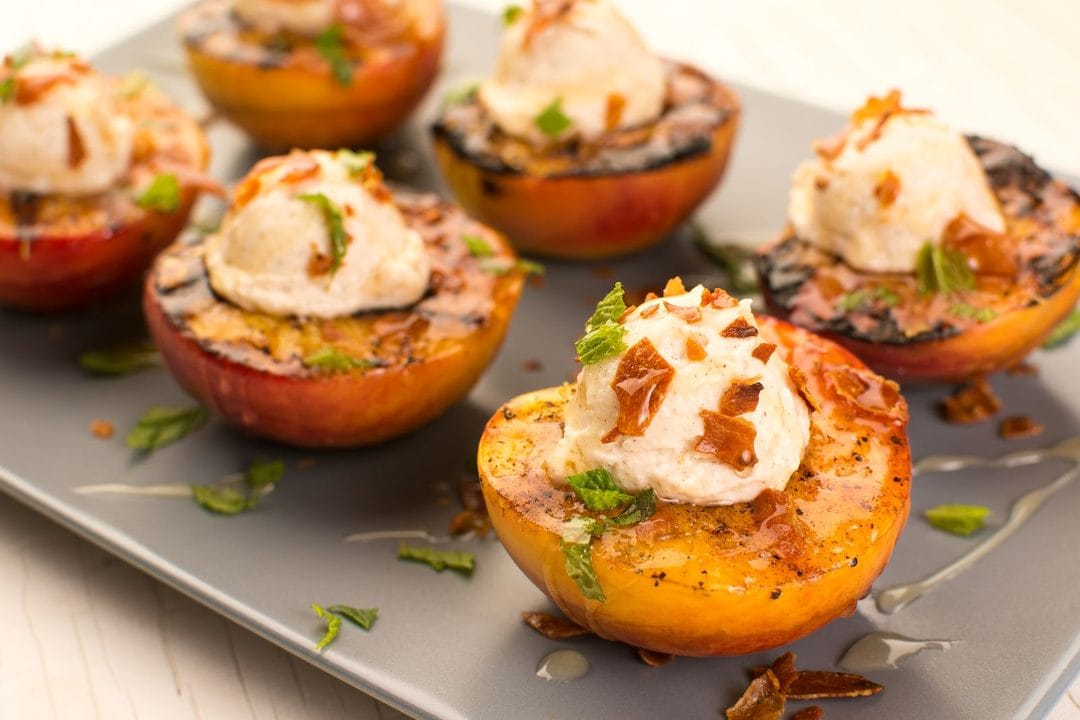
The coals are still glowing an hour after you've pulled the ribs off, the grate's still hot enough to sear, and there's a bowl of peaches sitting on the counter that came from the farmers market on Saturday for four dollars a pound. Most people let that heat go to waste. Five minutes on the grate turns those peaches into the best dessert you'll serve all summer, and it barely counts as cooking.
Grilled peaches work because of something that's easy to forget once you've spent all day thinking about brisket and pork shoulder: sugar caramelizes, and fruit is mostly sugar and water sitting behind a thin skin. Direct heat on a cut peach does the same thing a hot pan does to a seared scallop — it drives off surface moisture fast, browns the natural sugars into something closer to caramel, and leaves the inside soft and warm without turning to mush, as long as you don't leave it there too long. The char marks aren't just decoration. They're where most of the flavor actually happens, the same way a good crust on a steak isn't just texture, it's the Maillard reaction doing real work on your behalf. Restaurants have known this for decades, which is why grilled stone fruit shows up on so many summer dessert menus at fifteen dollars a plate for something that costs about sixty cents to make at home. You already have the fire going. There's no reason to pay someone else for five minutes of grate time you were about to have anyway.
Picking a Peach That Won't Fall Apart on the Grate
Freestone peaches are the better choice here, and it isn't close. Clingstone varieties — the kind where the flesh grips the pit and tears when you try to separate it — turn into a stringy mess the second you try to slice them in half for the grill, and you'll spend more time fighting the fruit than eating it. Freestone peaches, the kind most farmers markets sell from mid-July through August, split cleanly with a twist of the wrist once you've run a knife around the equator. Georgia and South Carolina peaches sold at this time of year are almost always freestone, and so are most of the California varieties that show up in grocery store bins labeled simply "yellow peach."
Ripeness matters more than variety, though. A peach that's rock-hard won't soften enough on five minutes of heat, and one that gives way like a water balloon under gentle thumb pressure will collapse into pulp before it ever gets grill marks. What you want is a peach that yields slightly at the stem end but still holds its shape when you press it — firm-ripe, the way a good avocado feels the day before it's perfect for guacamole. If the peaches you bought are still a little firm, leave them on the counter for a day or two rather than the fridge, since cold temperatures stop the ripening process almost entirely.
The Method
Halve the peach along its natural seam, twist to separate the two halves, and pop the pit out with your thumb or the tip of a paring knife.
Brush the cut side lightly with melted butter or neutral oil — a pastry brush works, but the back of a spoon does the job just as well — and set the halves cut-side down directly over medium heat, somewhere around 350-400°F if you're working off a smoker thermometer or the hand test if you're not. Leave them alone for three to four minutes. Resist the urge to move them around, because the sugars need uninterrupted contact with the grate to actually caramelize rather than just steam. You'll know they're ready when the cut side has real grill marks and the peach releases from the grate without sticking, which usually happens right around the same time the edges start looking slightly translucent.
Turning It Into Dessert
A grilled peach on its own is already good. A few small additions turn it into something people ask you to make again.
- A drizzle of bourbon — Buffalo Trace or Four Roses both work fine, you don't need anything expensive — mixed with a spoonful of brown sugar and warmed briefly makes a glaze that soaks into the warm flesh in a way a cold sauce never could.
- Mascarpone or good vanilla ice cream, a small scoop right in the cavity where the pit used to be, melting slightly against the warm fruit.
- Toasted pecans or walnuts add crunch that the soft peach is missing entirely on its own.
- A few torn mint leaves or a scrape of lime zest brighten the whole thing up, and honestly, a pinch of flaky salt does more for a grilled peach than most people expect from something that simple — that's about as far as the toppings list needs to go, though a splash of cream on the side never hurts.
Don't overthink the pairing. This isn't a dish that rewards complexity — it rewards restraint, and the best version most pitmasters make is the one with the fewest ingredients standing between the peach and your fork.
Any Fire Will Do
This works whether you're finishing up on a Weber kettle, a pellet grill like a Traeger, or the offset smoker you've had running since six in the morning. Charcoal gives the cleanest char and, honestly, the best flavor, since the residual smoke clinging to the grate after a long cook does something a clean gas burner just can't replicate. Gas works fine too, and it's faster to get to temperature if you're not already mid-cookout — just don't skip preheating the grate, since a cold grate is the number one reason peaches stick and tear instead of releasing cleanly. Pellet smokers running around 350°F handle this without any adjustment at all, which is part of why so many backyard cooks discover grilled peaches almost by accident, tossed on next to the ribs during the last few minutes of a cook. If you're working over hardwood lump charcoal, push the coals to one side so you've got a hotter zone for the peaches and a cooler one for anything else still finishing up, rather than trying to manage two different jobs over the same fire.
Where People Go Wrong
The most common mistake is heat that's too high, run for too long, on fruit that was already soft. A peach isn't a brisket — it doesn't need low and slow, and it definitely doesn't forgive being left unattended the way a pork shoulder does. Three or four minutes over direct medium heat is the ceiling for most fires. Go longer and the sugars that caramelized so nicely in minute three start to burn by minute six, turning bitter instead of sweet. That's the one contradiction worth sitting with here: everything else on your smoker rewards patience, and this is the one thing on the whole cookout that punishes it. Set a timer if you have to, because it's genuinely easy to lose track while you're also plating ribs and pouring drinks for six people standing around the patio. A scorched peach isn't salvageable the way an overcooked brisket sometimes is — there's no rest, no foil, no second chance once the sugar's gone past caramel into carbon.
The other mistake is skipping the fire altogether and using a grill pan indoors because it's "close enough." It isn't. Wood smoke and live coals add a faint smokiness that no stovetop grill pan will ever replicate, and if you're already firing up the smoker for ribs or a shoulder, the last five minutes before you shut the vents down is exactly when those peaches should be hitting the grate — not the next morning, reheated, from a pan.
That bowl of peaches on the counter, the four-dollar-a-pound kind from the Saturday market, doesn't need a recipe card or a trip to the store for anything but bourbon you probably already own. It needs five minutes of heat you were about to waste anyway.