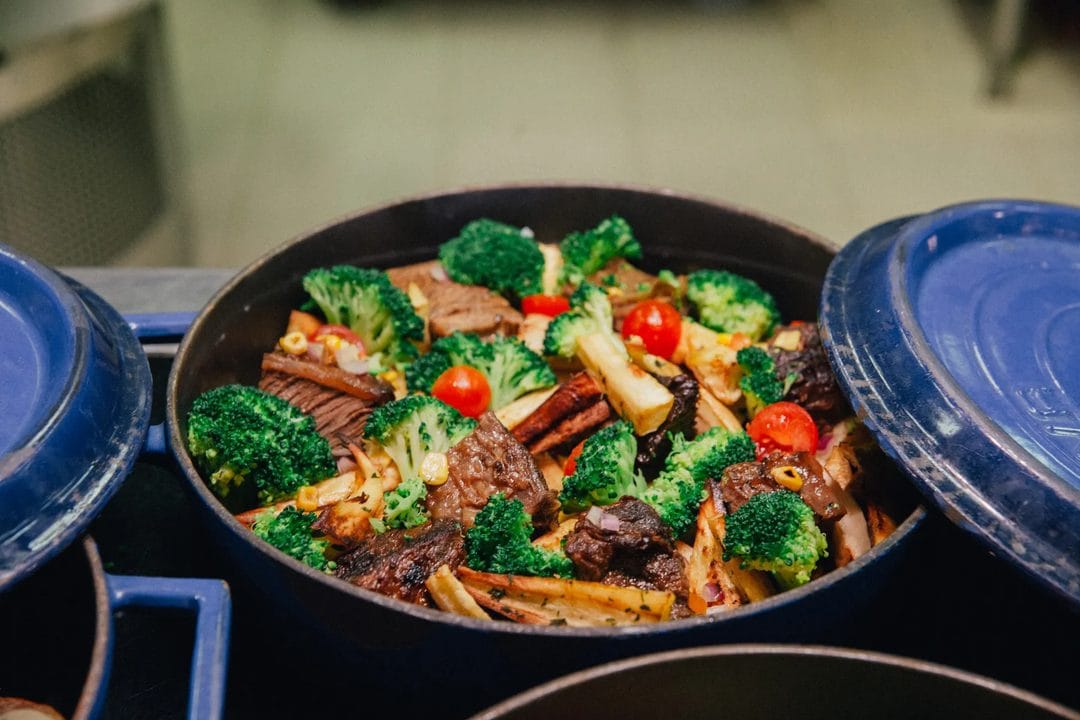
The smoker cover went on Tuesday morning, the one with the faded Aggie logo that has outlived three actual smokers. Labor Day weekend is the unofficial closing ceremony for backyard barbecue in most of the country, and by the time the last pulled pork sandwich gets eaten cold out of the fridge on Wednesday, a lot of home cooks quietly put the wood chips away until Memorial Day. What they don't always realize is that the technique they've spent all summer chasing on a 225-degree smoker has an indoor cousin that works just as well in September, October, and November — and it lives in a five-quart pot that never leaves the stovetop.
Braising Is Just Low and Slow Without the Weather Problem
Braising and smoking share the same core physics: connective tissue like collagen won't break down into gelatin until it spends hours at a temperature well below what you'd use for a quick sear. A brisket point needs to sit between 195 and 205 degrees internal for hours before it's fork-tender, and a chuck roast in a Dutch oven is chasing the exact same target, just through a different heat source. The smoker gets there with indirect heat and smoke particles doing double duty as flavor and preservative. The Dutch oven gets there with braising liquid, a tight lid, and an oven set to 300 or 325 degrees that nobody has to monitor with a phone app at 2 a.m. That's the trade worth making once the weather turns. Standing outside refilling a hopper or babysitting a stall at 165 degrees is a genuine pleasure in July, when the alternative is being inside anyway. In November, when it's 40 degrees and raining sideways, checking a Dutch oven through the oven window every 45 minutes is not a downgrade — it's the better version of the same cooking method for the season you're actually in. Braising also forgives a schedule in a way smoking rarely does: a pot roast that needs another 40 minutes doesn't ruin dinner, it just means appetizers run a little longer.
The Pot You Actually Need, and the Ones You Don't
A 5.5 to 7-quart enameled Dutch oven is the single most useful pot in a kitchen that takes braising seriously, and the price range on that category is wide enough to cause real decision paralysis. Lodge's 6-quart enameled cast iron runs about $69 at Target and performs the actual physics of braising — even heat retention, a heavy lid that seals in moisture — just as well as pots costing five times more. Le Creuset's Signature 7.25-quart sits around $380 and Staub's comparable size lands near $350; both have marginally better enamel durability and lids designed to redistribute condensation back onto the food, which matters if you're braising three times a week for a decade, and matters much less if you're doing it a dozen times a season.
Buy the Lodge. That's not a hedge — for anyone cooking through a normal fall and winter rotation of pot roasts, short ribs, and braised chicken thighs, the enamel will outlast the impulse to upgrade, and the $300 saved buys a lot of chuck roast. The one place spending more actually pays off is if the pot is also doing double duty as a bread oven or a serving vessel that goes straight to the table — Staub's matte black interior and the slightly heavier lid genuinely sear better because it holds heat more aggressively, which matters for a recipe like French onion soup gratin finished under a broiler. For everything else, the $69 pot and the $380 pot produce the same braised short ribs.
What Actually Belongs in the Pot Right Now
Early September sits at an awkward produce crossroads — the last of summer tomatoes are still around, but apples and winter squash are arriving in force, and that overlap is exactly where the best braises of the season come from. Honeycrisp apples are running $1.99 to $2.49 a pound at most grocery chains right now, firm enough to hold their shape through a two-hour braise without turning to applesauce, which makes them a genuinely underused addition to braised pork shoulder or chicken thighs — the acid and sugar cut through the fat in a way that a splash of vinegar alone doesn't.
Butternut squash, usually $0.99 to $1.29 a pound whole, is the other ingredient worth building a menu around this month. Cubed and added to a braise in the last 45 minutes rather than the first two hours, it holds its shape and picks up whatever the braising liquid is doing — beef stock and red wine, apple cider and mustard, or a simple chicken stock with sage. Adding it too early is the most common mistake: squash added at the start of a three-hour braise disintegrates into the sauce, which isn't a disaster exactly, but it's not what most people are picturing when they plan the dish.
- Honeycrisp or Braeburn apples — firm enough to survive a long braise; Red Delicious will not
- Butternut or acorn squash, added in the final 45 minutes for texture
- Fresh sage and thyme, both still cheap and abundant at farmers markets through October
- Cider vinegar or a dry hard cider, for the acid a braise needs to avoid tasting flat
The Leftover-Smoker Braise Nobody Talks About
Here's the move that actually bridges the two seasons instead of just replacing one with the other: a pound or two of leftover smoked pulled pork or brisket, chopped and added to a braise built around beans, apple cider, and a diced onion, turns three-day-old barbecue into something that tastes intentional rather than reheated. The smoke flavor that's already baked into the meat does the seasoning work a normal braise spends two hours building from scratch. Brown the onion, add a can of diced tomatoes, two cups of chicken stock, a cup of hard cider, drained cannellini or great northern beans, and the chopped smoked meat, then let it go at 300 degrees for 90 minutes with the lid on.
This is where a lot of home cooks get stuck on a mental script that says smoked meat belongs on a bun or a plate by itself, not folded into a stew. It doesn't have to work that way. A smoked brisket that's gone a little dry after three days in the fridge — which happens to almost every brisket, even a good one — gets a second life once it's simmering in liquid again, because the braise rehydrates exactly the tissue the smoker dried out. Skip this step and that last pound of Labor Day brisket usually ends up in the trash around Thursday.
Timing That Doesn't Require Guesswork
Braising temperature and timing follow a fairly predictable formula once the cut and the liquid level are set. A 3 to 4-pound chuck roast, covered two-thirds of the way up with liquid and cooked at 300 degrees, needs roughly 3 to 3.5 hours before it shreds with a fork rather than resisting it. Bone-in chicken thighs are much faster — 45 to 60 minutes at 325 degrees — because there's far less connective tissue to convert. Short ribs sit in between, usually 2.5 to 3 hours, and the tell isn't a timer at all: a properly braised short rib offers almost no resistance when a fork twists against it, and if there's still pull-back or chew, it needs another 20 minutes regardless of what the clock says. The one number worth writing down is the internal temperature target, even though most braising recipes skip it entirely and just say "fork-tender." Collagen conversion is reliably underway by 180 degrees internal and largely complete by 205 — the same window that matters for brisket on a smoker. A probe thermometer left in the pot removes the guesswork completely, and it's the same $15 tool most people already own from their BBQ season.
What This Doesn't Fix
Braising isn't a substitute for everything the smoker did well. Bark — that dark, seasoned crust on a properly smoked brisket or pork shoulder — simply doesn't form in a covered pot, because bark needs dry heat and hours of exposure to smoke and air, and a braise is doing the opposite: locking moisture in. A seared piece of meat browned in the Dutch oven before the liquid goes in gets close, with a rendered, caramelized surface from the Maillard reaction, but it's a different texture entirely, and pretending otherwise sets up a letdown. The right frame is that braising takes over the "long, unhurried cooking" job the smoker did all summer, not the smoke-and-bark job that's specific to the smoker itself.
The smoker will come back out for the occasional 50-degree Saturday between now and Thanksgiving — plenty of people run a smoker year-round in the Southeast and parts of the Southwest without much trouble. But for the stretch where the oven is already warming the kitchen and a three-hour cook doesn't mean standing outside, the Dutch oven earns its spot on the stove. The pot's already out. The squash is already in the cart.