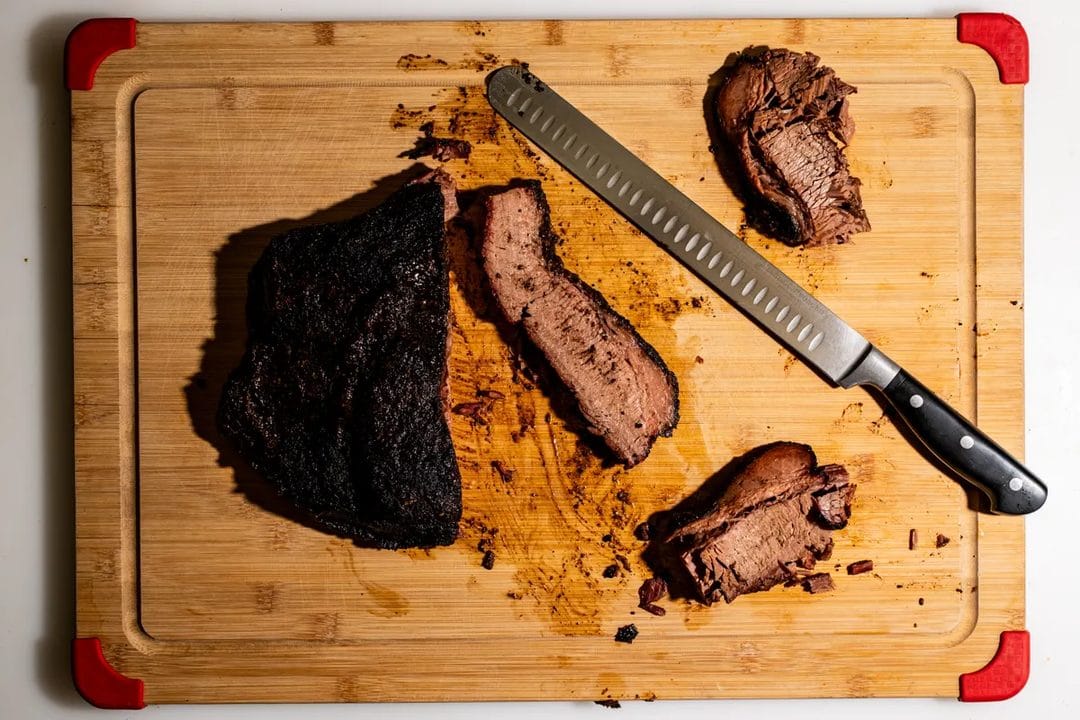
At Arthur Bryant's on 18th and Brooklyn in Kansas City, there used to be a pile of blackened brisket trim sitting next to the meat slicer, and nobody paid a dime for it. The counterman would just push it to the side, and anyone who wanted some helped themselves. That's how writer Calvin Trillin found it in 1972, and he loved it so much he put it in Playboy: "The main course at Bryant's, as far as I'm concerned, is something that is given away free — the burned edges of the brisket. I dream of those burned edges." A scrap pile became a national obsession off the back of one magazine piece, and it never really stopped.
The Cut Nobody Wanted
A whole packer brisket is really two muscles fused by a thick seam of fat: the flat, which slices into the neat pink rectangles you picture when someone says "brisket," and the point, sitting on top, marbled and irregular and hard to carve cleanly. Pitmasters used to trim the point away, chop it into cubes, and either toss it or give it to whoever was standing at the counter. The point runs fattier than the flat, which means it can take far more time in the smoker before it dries out — those exposed edges pick up smoke and bark on every side instead of just one, and the extra fat renders down into something closer to candy than meat. That's the whole trick. Burnt ends were never a separate recipe; they were what happened when you left the fattiest, ugliest part of the brisket in the pit a little longer than made sense to anyone watching the clock.
From Giveaway to Signature Dish
Kansas City barbecue traces back to Henry Perry, who started smoking meat out of an alley stand in the Garment District around 1908 and is generally credited as the city's founding pitmaster. Charlie Bryant worked for Perry and later opened his own place; his brother Arthur came to visit, stayed, and eventually took over the business after Charlie died, moving it to the address most people now think of as Kansas City barbecue's ground zero. Burnt ends were already a known thing among regulars well before Trillin ever sat down at the counter — but his 1972 essay is the reason people outside Missouri started asking their local barbecue joint if they had any. Once demand showed up, the economics of "free scraps" stopped making sense. Wholesalers started selling brisket points on their own, restaurants built menu items and even sandwiches around them, and a dish that began as a way to use up trim became something cooks now smoke on purpose, at scale, because customers will drive across town for it. You'll find burnt ends worked into chili, into pizza toppings, even into ice cream around Kansas City today — a strange arc for something a counterman used to give away because nobody thought it was worth charging for.
The Real Method: Smoke, Cube, Sauce, Smoke Again
Most home cooks quit exactly one step too early.
If you're working from a whole packer brisket, separate the point from the flat once the whole thing hits an internal temperature of around 165°F to 170°F and the bark has set — this is roughly the same stage where you'd wrap the flat if you were pushing through a stall. Slide the point back onto the smoker by itself and keep going until it probes tender, somewhere around 195°F to 200°F internally. Pull it, let it rest for fifteen minutes so the juices redistribute instead of running straight out onto the cutting board, then cube it into three-quarter-inch to one-inch pieces. Toss the cubes in a shallow foil pan with enough barbecue sauce to coat every side — not drown them, coat them — and put the pan back on the smoker at 250°F for another 45 minutes to an hour. What comes out is sticky, dark, and caramelized on the outside with a texture that's closer to candied bacon than sliced brisket. Skip that second smoke and you've just got sauced brisket cubes, which are fine, but they're not burnt ends.
No Packer Brisket? Try the Poor Man's Version
A whole packer brisket runs $3.50 to $4.50 a pound at a warehouse club like Costco or Sam's Club if you catch a sale, and a 12-to-14-pound packer is a serious commitment of time, freezer space, and smoker real estate. Chuck roast solves most of that. At roughly $6 to $7 a pound and sold in three-to-four-pound cuts, a chuck roast has enough intramuscular fat and connective tissue to survive the same low-and-slow treatment, which is why cooks started calling the result "poor man's burnt ends" — same cubing-and-double-smoke technique, a fraction of the cook time and the price. Smoke the whole roast at 250°F until it hits around 165°F internally, then wrap or pan it, push through to 203°F to 205°F, and you'll get that same probe-tender, falls-apart-if-you-push-it texture the point delivers on a full brisket. It won't fool a Kansas City native who grew up on Arthur Bryant's — the flavor is beefier and slightly less rich than true brisket point — but on a Tuesday when you don't have twelve hours to babysit a smoker, it's the better call, full stop.
Here's the part most recipes gloss over: pulling the roast too early, in the name of saving time, is the single most common way this goes wrong. Some cooks pull at 195°F because they're worried about drying the meat out during the second smoke, and that's a reasonable instinct with a lean cut — but chuck roast has enough fat running through it that undercooking is the actual risk here, not overcooking. Push to 203°F minimum before you cube it. If the probe meets any resistance at all, it's not ready, no matter what the clock says.
The Sauce Argument
Kansas City sauce is sweet, thick, tomato-and-molasses based — think Gates Bar-B-Q or a homemade blend built around ketchup, brown sugar, and a good dose of black pepper — and it's the right call for burnt ends specifically, even if you lean toward a thinner, more vinegar-forward sauce for pulled pork or ribs. The reason is structural: burnt end cubes have way more surface area than a sliced brisket, so a thin sauce just runs off during that second smoke instead of caramelizing into the meat. A thick sauce clings, sugars up, and turns into that sticky lacquer people associate with the dish. Don't reach for a Carolina vinegar sauce here or a thin Texas-style mop — they're excellent on other cuts, but they'll leave your burnt ends looking sauced rather than glazed.
How to Serve Them
The classic move is the simplest one: burnt ends piled on a slice of white bread with a few dill pickle chips and raw onion, the way Arthur Bryant's has served them for decades. Restaurants around Kansas City now put them over crinkle-cut fries as "burnt end fries," or on a loaded baked potato, or scattered across nachos with pepper jack and pickled jalapeños — all reasonable, none of them improvements on the original. A cube of burnt end straight off the cutting board, no bread, no fries, still warm enough that the fat is soft — that's the actual best way to eat one, and anyone serving them at a cookout should expect at least half the batch to disappear before it ever reaches a plate.
If you're building a Kansas City-style spread for a backyard gathering, burnt ends work best as the centerpiece rather than a side dish — put them out warm, in the pan they finished cooking in, and let people serve themselves the way Bryant's regulars always did. A $22 plate at Jack Stack or Joe's Kansas City buys you a version dialed in over decades of practice, but a chuck roast, a full weekend afternoon, and a thick coat of sauce will get most home cooks close enough that nobody at the table is going to complain.