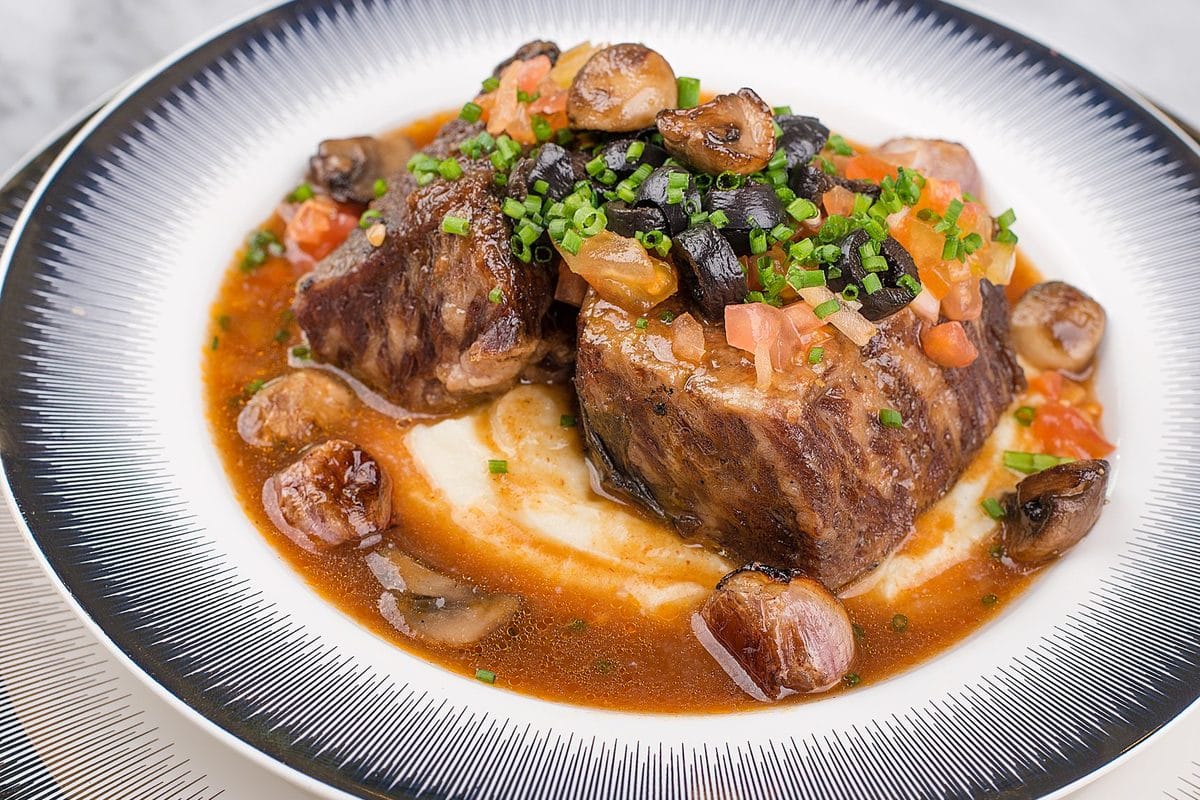
You've had the Dutch oven in the oven for three hours. The kitchen smells like a Sunday afternoon should smell — beef, red wine, thyme, the sweetness of onions gone soft and dark at the edges. You lift the lid, spear a rib with a fork, and instead of the meat falling away in shreds, it resists. It's not raw, exactly. It's just chewy, the way a cheap steak gets chewy when you cook it the wrong way. Something went sideways between the recipe card and the roasting pan, and it almost certainly wasn't the recipe.
The Temperature Mistake Almost Everyone Makes
Most home braises fail for one reason: the oven runs too hot. A recipe that says "325°F for three hours" sounds reasonable enough, but at that temperature the liquid inside a covered Dutch oven can climb close to a low boil, and boiling is exactly what turns short ribs tough. Collagen — the connective tissue that makes cheap, hardworking cuts like short ribs, chuck, and oxtail worth braising in the first place — doesn't dissolve into gelatin on a fixed timer. It converts within a specific temperature band, roughly 160°F to 205°F held over hours, and it needs slow, steady heat to get there without also squeezing the moisture out of the muscle fibers around it. Push the oven higher to try to save time, and the proteins seize up fast, moisture gets forced out, and the meat ends up drier and tougher than if it had never gone in the oven at all. None of this is exotic food science, either — it's the same reason a smoker held steady at 225°F to 250°F breaks brisket down over twelve hours while a grill running twice as hot just dries the surface out and calls itself done early.
Drop the oven to 275°F, and go as low as 250°F for a particularly large or bone-in cut, giving it the extra 45 minutes to an hour that gentler heat demands. That's not a suggestion to hedge on — it's the single change that fixes most tough braises, full stop.
Picking a Cut That's Actually Built for This
Not every cut braises the same way, and the price per pound is usually a decent proxy for how much connective tissue is on offer. Boneless beef short ribs run $9 to $14 a pound at most grocery chains, including Kroger and Safeway, and their high fat-to-collagen ratio is what makes them close to foolproof once the oven temperature is right. Chuck roast, at $6 to $9 a pound, braises just as well and shreds even more dramatically, though it lacks the individual-portion presentation that makes short ribs feel like a dinner-party cut. Oxtail, when it's in stock — increasingly common at Whole Foods and at Latin and Caribbean groceries — costs more per pound than either, often $10 to $16, and it builds a gelatin-rich sauce neither of the other two can match on its own. None of these are premium cuts in the usual steakhouse sense, and that's really the point — braising exists specifically to make the toughest, cheapest parts of the animal worth eating. A butcher counter with steady short rib supply, rather than a single shrink-wrapped supermarket tray, is worth seeking out for better trim and the option to buy bone-in.
For a first attempt, buy the chuck roast. It's harder to overcook, cheaper to write off if something goes wrong, and the exact technique carries straight over to short ribs once the timing clicks.
The Liquid Ratio Nobody Explains Well
Cookbooks love to say braising liquid should come about halfway up the meat, and that's a fine starting point — but the type of liquid matters more than the depth. A mix of two parts beef stock to one part dry red wine, roughly 3 cups of liquid for four pounds of short ribs, gives enough acid to help break down connective tissue without the sauce turning sour. Skip the wine and the braise still works, but the finished sauce tastes flatter, missing the fruit-forward backbone that a mid-range Cabernet or Côtes du Rhône — the $12 to $18 bottle nobody was planning to drink on its own — builds in over three hours of slow reduction.
There's one exception worth naming here: too much liquid is its own failure mode. Submerge the meat completely and the pot is simmering, not braising, and the exposed top of each rib never gets the chance to caramelize against the lid or develop that slightly concentrated, almost jammy texture that separates a good braise from a pot roast that just happened to occur in the oven.
Tools Worth Spending On
A heavy pot with a tight-fitting lid matters here more than almost any other piece of equipment in the kitchen. Lodge's 6-quart enameled Dutch oven, around $89 at most retailers, holds heat evenly enough for the job and will outlast the stove it sits on. Le Creuset's equivalent runs closer to $380, and while the enamel finish and lid fit are genuinely nicer, the temperature performance gap for a three-hour braise is small enough that it's hard to justify unless the pot is also going to double as a serving piece at the table. What actually changes outcomes more reliably is a $35 instant-read thermometer — a ThermoWorks ThermoPop does the job fine — used to check internal temperature at the two-and-a-half-hour mark instead of guessing from the clock.
Common Culprits When It Still Comes Out Tough
- Oven set above 300°F, which turns a braise into a low boil
- Too little liquid, which dries out the top third of the meat before the bottom finishes braising through
- Pulling the pot at a fixed cook time instead of checking internal temperature — the single most common reason a braise misses 195°F
- Buying pre-trimmed, ultra-lean short ribs, which simply don't carry enough connective tissue to reach that spoon-tender texture no matter how long they sit in the oven, along with a few other cuts marketed as "lean" that quietly work against the whole method
How to Tell It's Actually Done
Forget the fork test as the only signal; it's useful, but it's also subjective, and subjective is how people end up serving undercooked short ribs at 7 p.m. with guests already seated. Internal temperature is the more honest number: short ribs braised to 195°F to 203°F pull apart with almost no resistance, while anything under 190°F is still mid-conversion regardless of how long it's technically been in the oven. Total time matters less than most recipes imply — a large, bone-in cut might need four hours at 275°F, while a smaller, well-trimmed piece can hit target temperature closer to two and a half.
So what about the stall people swear braised meat goes through, the same plateau brisket hits on a smoker? It's real, and it's the same mechanism — evaporative cooling combined with connective tissue converting slows the temperature climb somewhere around 160°F to 170°F — but inside a sealed Dutch oven with liquid, it's far less dramatic than on an open smoker grate, and it rarely needs any intervention beyond patience.
Why Resting It Overnight Beats Serving It Right Away
Braised short ribs are one of the few dishes that taste better the next day, and skipping that rest is where a lot of otherwise correct braises lose points at the table. Refrigerate the whole pot overnight and the fat that floated to the top solidifies into a solid cap that lifts off in one piece, taking most of the excess richness with it — something no amount of skimming with a spoon while the liquid is still hot ever manages as cleanly. The meat keeps absorbing the sauce as it cools, too, and reheating gently on the stovetop or in a 300°F oven for 20 to 30 minutes brings everything back to serving temperature without drying it out the way a microwave reliably does. Restaurants that put braised short ribs on the menu almost never cook them to order, and that's exactly why: the dish is built to be made a day ahead, and treating it that way at home costs nothing but a little patience and a spare shelf in the fridge.
The next time a braise comes out tough, check the oven temperature before blaming the recipe, the cut, or the three hours spent waiting. Most of the time, the dial was simply turned too high from the start.